
|
You entered: light
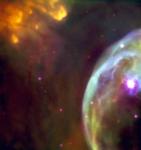 Close Up of the Bubble Nebula
18.11.1998
It's the bubble versus the cloud. NGC 7635, the Bubble Nebula, is being pushed out by the stellar wind of massive central star BD+602522. Next door, though, lives a giant molecular cloud, visible above to the upper left.
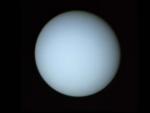 Uranus: The Tilted Planet
26.08.2001
Uranus is the third largest planet in our Solar System after Jupiter and Saturn. Uranus is composed mostly of rock and ices, but with a thick hydrogen and helium atmosphere. The blue hue of Uranus' atmosphere arises from the small amount of methane which preferentially absorbs red light.
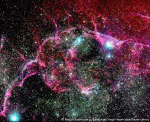 Vela Supernova Remnant in Optical
13.06.1996
About 11,000 years ago a star in the constellation of Vela exploded. This bright supernova may have been visible to the first human farmers. Today the Vela supernova remnant marks the position of a relatively close and recent explosion in our Galaxy. A roughly spherical, expanding shock wave is visible in X-rays.
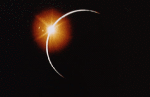 Apollo Sunrise
20.06.1996
In November of 1969, homeward bound aboard the "Yankee Clipper" command module, the Apollo 12 astronauts took this dramatic photograph of the Sun emerging from behind the Earth. From this distant perspective, part...
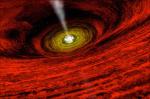 GRO J1655 40: Evidence for a Spinning Black Hole
1.06.2003
In the center of a swirling whirlpool of hot gas is likely a beast that has never been seen directly: a black hole. Studies of the bright light emitted by the swirling gas frequently indicate not only that a black hole is present, but also likely attributes.
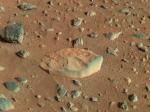 White Boat Rock on Mars
25.02.2004
What caused this rock to have an unusual shape? Earlier this month the robot Spirit rover on Mars stopped to examine a rock dubbed "white boat", named for its unusually light color and shape.
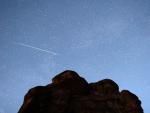 Comet Dust over Colorado
17.08.2006
The rock formation in the foreground of this night view was recorded on August 10, illuminated by light from a waning gibbous Moon. Even though the sky above also scatters the bright moonlight, a brilliant meteor was captured as it flashed across the scene during the 30 second long exposure.
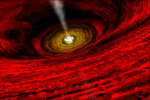 The View Near a Black Hole
19.04.2009
In the center of a swirling whirlpool of hot gas is likely a beast that has never been seen directly: a black hole. Studies of the bright light emitted by the swirling gas frequently indicate not only that a black hole is present, but also likely attributes.
 Markarians Chain of Galaxies
9.06.2009
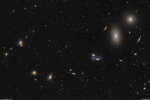
Across the heart of the Virgo Cluster of Galaxies lies a striking string of galaxies known as Markarian's Chain. The chain, pictured above, is highlighted on the upper right with two large but featureless lenticular galaxies, M84 and M86. Prominent to their lower left is a pair of interacting galaxies known as The Eyes.
 The Galaxy Tree
25.05.2015
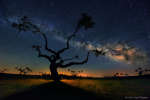
First came the trees. In the town of Salamanca, Spain, the photographer noticed how distinctive a grove of oak trees looked after being pruned. Next came the galaxy. The photographer stayed up until 2 am, waiting until the Milky Way Galaxy rose above the level of a majestic looking oak.
|
January February March April May June July August September October |
|||||||||||||||||||||||||||||||||||||||||||||||||