
|
You entered: light
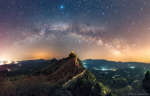 The Summer Triangle over the Great Wall
3.07.2017
Have you ever seen the Summer Triangle? The bright stars Vega, Deneb, and Altair form a large triangle on the sky that can be seen rising in the northern spring during the morning, and rising in the northern fall during the evening.
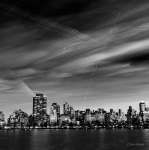 Manhattan Skylines
17.02.2018
City lights shine along the upper east side of Manahattan in this dramatic urban night skyscape from February 13. Composed from a series of digital exposures, the monochrome image is reminiscent of the time when sensitive black and white film was a popular choice for dimly lit night and astro-photography.
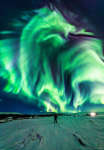 Dragon Aurora over Iceland
18.02.2019
Have you ever seen a dragon in the sky? Although real flying dragons don't exist, a huge dragon-shaped aurora developed in the sky over Iceland earlier this month. The aurora was caused...
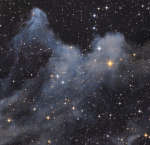 The Ghoul of IC 2118
29.10.2020
Inspired by the halloween season, this telescopic portrait captures a cosmic cloud with a scary visage. The interstellar scene lies within the dusty expanse of reflection nebula IC 2118 in the constellation Orion. IC 2118 is about 800 light-years from your neighborhood, close to bright bluish star Rigel at the foot of Orion.
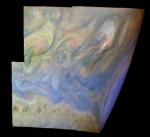 West Of The Great Red Spot
26.12.1997
The turbulent region West of Jupiter's Great Red Spot is highlighted in this recent picture constructed from data recorded by the Galileo spacecraft. The image is color coded to show cloud height and thickness; white clouds are high and thick, light blue clouds are high and thin, and reddish clouds are low.
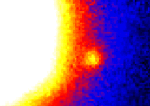 GL 229B: An Elusive Brown Dwarf?
4.12.1995
What type of matter makes up most of the universe? This question is arguably the most perplexing astronomical mystery of our time. A leading candidate is a type of dim, low mass star called a "brown dwarf" star.
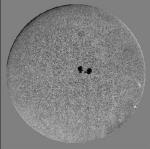 Grey Sun Seething
8.01.1997
The Sun's surface is not smooth. It has thousands of bumps called granules and usually a few dark depressions called sunspots. Each of the numerous granules is the size of an Earth continent, but much shorter lived.
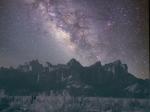 Heaven on Earth
23.02.2004
If sometimes it appears that the entire Milky Way Galaxy is raining down on your head, do not despair. It happens twice a day. As the Sun rises in the East, wonders of the night sky become less bright than the sunlight scattered by our own Earth's atmosphere, and so fade from view.
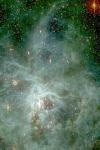 In the Heart of the Tarantula Nebula
27.10.1999
In the heart of monstrous Tarantula Nebula lies one of the most unusual star clusters. Known as NGC 2070 or R136, it is home to a great number of hot young stars. The energetic light from these stars continually ionizes nebula gas, while their energetic particle wind blows bubbles and defines intricate filaments.
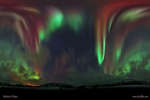 A Full Sky Aurora Over Norway
3.01.2012
Higher than the highest building, higher than the highest mountain, higher than the highest airplane, lies the realm of the aurora. Auroras rarely reach below 60 kilometers, and can range up to 1000 kilometers. Aurora light results from energetic electrons and protons striking molecules in the Earth's atmosphere.
|
January February March April May June July August September October |
|||||||||||||||||||||||||||||||||||||||||||||||||