
|
You entered: light
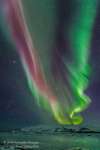 Orion and Aurora over Iceland
24.03.2014
If you see a sky like this -- photograph it. A month ago in Iceland, an adventurous photographer (pictured) chanced across a sky full of aurora and did just that. In the foreground lies the stratovolcano жrФfajЖkull. In the background, among other sky delights, lies the constellation of Orion, visible to the aurora's left.
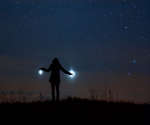 Jupiter and Venus from Earth
17.08.2014
It was visible around the world. The sunset conjunction of Jupiter and Venus in 2012 was visible almost no matter where you lived on Earth. Anyone on the planet with a clear western horizon at sunset could see them.
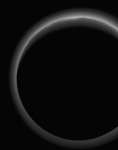 Pluto at Night
20.10.2019
The night side of Pluto spans this shadowy scene, a stunning spacebased view with the Sun 4.9 billion kilometers (almost 4.5 light-hours) behind the dim and distant world. It was captured by far flung New Horizons in July of 2015.
 Pluto at Night
26.03.2022
The night side of Pluto spans this shadowy scene. In the stunning spacebased perspective the Sun is 4.9 billion kilometers (almost 4.5 light-hours) behind the dim and distant world. It was captured...
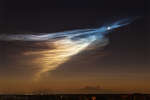 APOD: 2024 July 9 Б Noctilucent Clouds over Florida
9.07.2024
These clouds are doubly unusual. First, they are rare noctilucent clouds, meaning that they are visible at night -- but only just before sunrise or just after sunset. Second, the source of these noctilucent clouds is actually known.
 Pluto at Night
16.11.2024
The night side of Pluto spans this shadowy scene. In the stunning spacebased perspective the Sun is 4.9 billion kilometers (almost 4.5 light-hours) behind the dim and distant world. It was captured...
 The Snake Nebula from CFHT
9.04.2002
What slithers overhead? The dark winding lanes visible in part of the constellation of Ophiuchus belong to the Snake Nebula. Also known as Barnard 72, the Snake Nebula is a series of dark absorption clouds made up of molecular gas and interstellar dust.
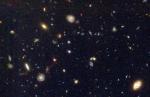 A Deep Field In The Southern Sky
29.06.2002
This deep view of the cosmos is the sequel to the 1995 hit Hubble Space Telescope Deep Field. Billed as the Hubble Deep Field South, it was produced by pointing the space telescope toward a patch of sky in the southern constellation Tucana.
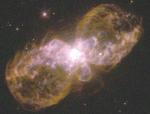 The Hubble 5 Planetary Nebula
19.01.1998
The Hubble Double Bubble Planetary Nebula is bubbling over with excitement. More mundanely known as Hubble 5, this bipolar planetary nebula is being created by a hot wind of particles streaming away from the central star system.
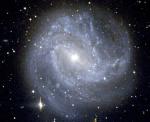 M83: A Barred Spiral Galaxy
25.05.1998
M83 is a bright spiral galaxy that can be found with a small telescope in the constellation of Hydra. M83 is a member of the Centaurus group of galaxies, a nearby group dominated by the massive galaxy Centaurus A. It takes light about 15 million years to reach us from M83.
|
January February March April May June July August September October |
|||||||||||||||||||||||||||||||||||||||||||||||||