
|
You entered: light
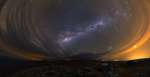 Atacama s Cloudy Night
27.07.2013
Storm clouds do sometimes come to Chile's Atacama desert, known as the driest place on Earth. These washed through the night sky just last month during the winter season, captured in this panoramic view.
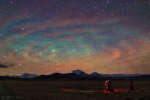 Airglow Ripples over Tibet
1.09.2014
Why would the sky look like a giant target? Airglow. Following a giant thunderstorm over Bangladesh in late April, giant circular ripples of glowing air appeared over Tibet, China, as pictured above. The unusual...
 M100: A Grand Design Spiral Galaxy
25.12.2018
Majestic on a truly cosmic scale, M100 is appropriately known as a grand design spiral galaxy. It is a large galaxy of over 100 billion stars with well-defined spiral arms that is similar to our own Milky Way Galaxy.
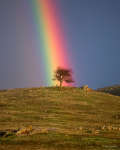 APOD: 2023 March 13 Б Rainbow Tree
13.03.2023
What lies at the end of a rainbow? Something different for everyone. For the photographer taking this picture, for example, one end of the rainbow ended at a tree. Others nearby, though, would likely see the rainbow end somewhere else. The reason is because a rainbow's position depends on the observer.
 APOD: 2024 December 2 Б NGC 300: A Galaxy of Stars
2.12.2024
This galaxy is unusual for how many stars it seems that you can see. Stars are so abundantly evident in this deep exposure of the spiral galaxy NGC 300 because so many of these stars are bright blue and grouped into resolvable bright star clusters.
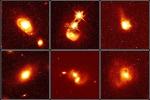 A Quasar Portrait Gallery
6.12.1997
QUASARs (QUASi-stellAR objects) lie near the edge of the observable Universe. Discovered in 1963, astronomers were astounded that such objects could be visible across billions of light-years, as this implies they must emit prodigious amounts of energy. Where does the energy come from?
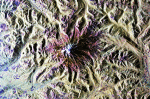 A Radar Image of Planet Earth
24.08.1995
This image of Mt. Rainier, Washington USA, planet Earth, was produced by the Spaceborne Radar Laboratory which flew on the Space Shuttle Endeavour in 1994. Radar, short for RAdio Detection And Ranging...
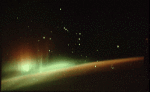 Aurora and Orion
14.11.1995
Looking toward the south from low Earth orbit, the crew of the Space Shuttle Endeavor made this stunning time exposure of the Aurora Australis (southern lights) in April of 1994. The aurora are caused by high energy electrons from the Solar Wind which are funneled into the atmosphere by the Earth's magnetic field.
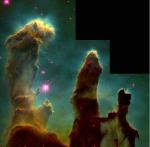 From Eagle's EGGs A Star Is Born
19.01.1997
Perhaps the most famous astronomical image in recent years reveals newborn stars upon pillars of gas and dust - uncovered as researchers used the Hubble Space Telescope to explore the Eagle Nebula in 1995. This...
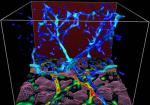 A Universe in a Box
21.08.1997
Is this our universe? Possibly. It is one computerized guess of how gas in the universe was distributed billions of years ago, at redshift 3, when the universe was only a quarter of its present age.
|
January February March April May June July August September October |
|||||||||||||||||||||||||||||||||||||||||||||||||