
|
You entered: light
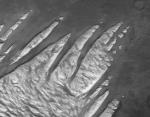 White Rock Fingers on Mars
13.05.2002
What caused this unusual white rock formation on Mars? Intrigued by the possibility that they could be salt deposits left over as an ancient lakebed dried-up, detailed studies of these fingers now indicate a more mundane origin: volcanic ash. Studying the exact color of the formation indicated the volcanic origin.
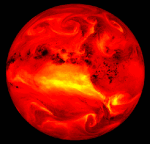 The Water Vapor Channel
12.10.1996
What alien planet's bizarre landscape lurks below these fiery-looking clouds? It's only Planet Earth, of course -- as seen on the Water Vapor Channel. Hourly, images like this one (shown in false color) are brought to you by the orbiting GOES 8 satellite's multi-channel imager.
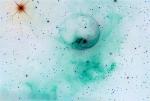 The Bubble Nebula from NOAO
17.06.2003
It's the bubble versus the cloud. NGC 7635, the Bubble Nebula, is being pushed out by the stellar wind of massive central star BD+602522. Next door, though, lives a giant molecular cloud, visible above to the lower right.
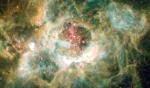 In the Center of NGC 604
5.03.1997
Stars are sometimes born in the midst of chaos. About 3 million years ago in the nearby galaxy M33, a large cloud of gas spawned dense internal knots which gravitationally collapsed to form stars. But NGC 604 was so large, it could form enough stars to make a globular cluster.
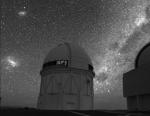 A Cerro Tololo Sky
13.03.2004
High atop a Chilean mountain lies one of the premier observatories of the southern sky: the Cerro Tololo Inter-American Observatory (CTIO). Pictured above is the dome surrounding one of the site's best known instruments, the 4-meter Blanco Telescope.
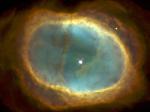 NGC 3132: The Eight Burst Nebula
6.02.2005
It's the dim star, not the bright one, near the center of NGC 3132 that created this odd but beautiful planetary nebula. Nicknamed the Eight-Burst Nebula and the Southern Ring Nebula, the glowing gas originated in the outer layers of a star like our Sun.
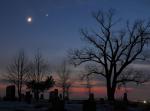 December Moon Meets Evening Star
9.12.2005
If you've been outdoors near sunset, then you've probably noticed Venus low in the west as the brilliant evening star. Sometimes mistaken for a tower light near the horizon, Venus is the third brightest celestial beacon, after the Sun and Moon, in planet Earth's sky.
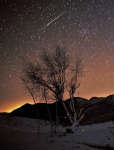 A Meteor Moment
17.12.2010
Intensely bright, this fireball meteor flashed through Tuesday's cold, clear, early morning skies over the Karakas Mountains in central Iran, near the peak of the annual Geminid Meteor Shower. To capture the meteor moment and wintery night skyscape, the photographer's camera was fixed to a tripod, its shutter open for about 1.5 minutes.
 The Terraced Night
6.02.2014
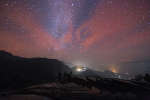
Long after sunset on January 25 an unusually intense red airglow floods this south-looking skyscape. The scene was recorded with a long exposure using a digital camera over Yunnan Province in southwest China. At best faintly visible to the eye, the lingering airglow is due to chemiluminescence, the production of light through chemical excitation.
 M1: The Crab Nebula from Hubble
9.09.2018
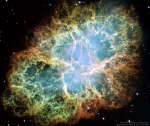
This is the mess that is left when a star explodes. The Crab Nebula, the result of a supernova seen in 1054 AD, is filled with mysterious filaments. The filaments are not only tremendously...
|
January February March April May June July August September October |
|||||||||||||||||||||||||||||||||||||||||||||||||