
|
You entered: light
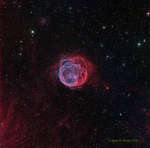 Henize 70: A Superbubble in the LMC
4.02.2019
Massive stars profoundly affect their galactic environments. Churning and mixing interstellar clouds of gas and dust, stars -- most notably those upwards of tens of times the mass of our Sun -- leave their mark on the compositions and locations of future generations of stars.
 APOD: 2023 December 4 Б Plane Crossing Crescent Moon
4.12.2023
No, the Moon is not a bow, and no, it did not shoot out a plane like an arrow. What is pictured is a chance superposition. The plane's contrail would normally appear white...
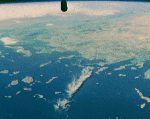 Aristarchus' Unbelievable Discoveries
14.09.1996
Here lived one of the greatest thinkers in human history. Aristarchus lived on the Greek island of Samos, a small island in the center of the above picture that can be identified with a good map.
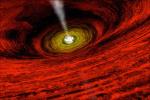 GRO J1655 40: Evidence for a Spinning Black Hole
8.05.2001
In the center of a swirling whirlpool of hot gas is likely a beast that has never been seen directly: a black hole. Studies of the bright light emitted by the swirling gas frequently indicate not only that a black hole is present, but also likely attributes.
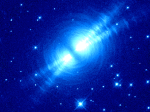 Searchlight Beams from the Egg Nebula
29.01.1996
The dramatic and mysterious looking object revealed in this Hubble Space Telescope image is known as the Egg Nebula. It is an aging star about 3,000 lightyears distant, entering its Planetary Nebula phase of evolution.
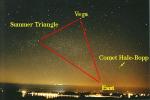 Vega
Vega
15.07.1997
Vega is a bright blue star 25 light years away. Vega is the brightest star in the Summer Triangle, a group of stars easily visible summer evenings in the northern hemisphere. The name Vega...
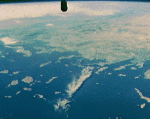 Aristarchus' Unbelievable Discoveries
8.11.1997
Here lived one of the greatest thinkers in human history. Aristarchus lived on the Greek island of Samos, a small island in the center of the above picture that can be identified with a good map.
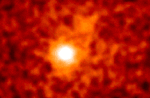 Gamma Ray Quasar
26.12.1998
The bright object in the center of the false color image above is quasar 3C279 viewed in gamma-rays, photons with more than 40 million times the energy of visible light. Like all quasars, 3C279 is a nondescript, faint, star-like object in the visible sky.
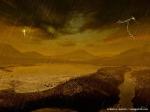 Methane Rain Possible on Titan
2.08.2006
Might it rain cold methane on Saturn's Titan? Recent analyses of measurements taken by the Huygen's probe that landed on Titan in 2005 January indicate that the atmosphere is actually saturated with methane at a height of about 8 kilometers.
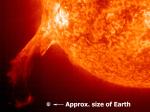 An Erupting Solar Prominence from SOHO
7.08.2006
Our Sun is still very active. In the year 2000, our Sun went though Solar Maximum, the time in its 11-year cycle where the most sunspots and explosive activities occur. Sunspots, the Solar Cycle, and solar prominences are all caused by the Sun's changing magnetic field.
|
January February March April May June July August September October |
|||||||||||||||||||||||||||||||||||||||||||||||||