
|
You entered: light
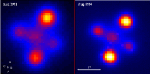 Microlensing of the Einstein Cross
11.07.1995
The famous "Einstein Cross" is a case where a single object is seen four times. Here a very distant QSO happened to be placed right behind a massive galaxy. The gravitational effect...
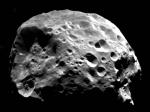 Phoebe: Comet Moon of Saturn
30.06.2004
Was Saturn's moon Phoebe once a comet? Images from the robotic Cassini spacecraft taken two weeks ago when entering the neighborhood of Saturn indicate that Phoebe may have originated in the outer Solar System.
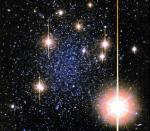 Pegasus dSph: Little Galaxy of the Local Group
22.01.1999
The Pegasus dwarf spheroidal galaxy (Peg dSph) is a small, newly recognized member of the Local Group of Galaxies. Likely a satellite companion of the Local Group's dominant player, the large spiral Andromeda (M31), the Pegasus dwarf galaxy is almost hidden in the glare of relatively bright foreground stars in our own Milkyway.
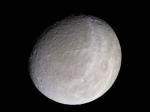 Saturns Moon Rhea from Cassini
15.02.2005
Each moon of Saturn seems to come with its own mystery. Rhea, Saturn's second largest moon behind Titan, shows unusual wisps, visible above as light colored streaks. Higher resolution images of the wisps show them to be made of long braided fractures.
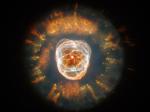 The Eskimo Nebula from Hubble
9.07.2006
In 1787, astronomer William Herschel discovered the Eskimo Nebula. From the ground, NGC 2392 resembles a person's head surrounded by a parka hood. In 2000, the Hubble Space Telescope imaged the Eskimo Nebula. From space, the nebula displays gas clouds so complex they are not fully understood.
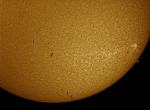 Mercury and the Chromosphere
10.11.2006
Enjoying Wednesday's transit of Mercury from Dallas, Texas, astronomer Phil Jones recorded this detailed image of the Sun. Along with a silhouette of the innermost planet, a network of cells and dark filaments can be seen against a bright solar disk with spicules and prominences along the Sun's edge.
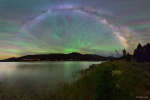 An Airglow Fan from Lake to Sky
27.01.2016
Why would the sky look like a giant fan? Airglow. The featured intermittent green glow appeared to rise from a lake through the arch of our Milky Way Galaxy, as captured last summer next to Bryce Canyon in Utah, USA.
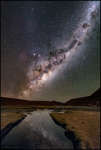 The Altiplano Night
7.07.2016
The Milky Way is massively bright on this cold, clear, altiplano night. At 4,500 meters its reflection in a river, a volcanic peak on the distant horizon, is captured in this stitched panorama under naturally dark skies of the northern Chilean highlands near San Pedro de Atacama.
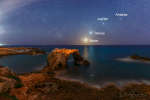 Celestial Alignment over Sicilian Shore
4.03.2019
This was a sunrise to remember. About a month ago, just before the dawn of the Sun, an impressive alignment of celestial objects was on display to the east. Pictured, brightest and closest to the horizon, is the Moon.
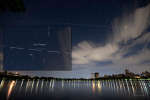 Dragon over Central Park
5.06.2020
Still bathed in sunlight the International Space Station (ISS) arced through this Manhattan evening sky on May 30. Moving left to right, its bright trail was captured in this composite image with a series of 5 second long exposures.
|
January February March April May June July August September October |
|||||||||||||||||||||||||||||||||||||||||||||||||