
|
You entered: light
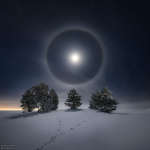 Lunar Halo over Snowy Trees
1.02.2021
Have you ever seen a halo around the Moon? This fairly common sight occurs when high thin clouds containing millions of tiny ice crystals cover much of the sky. Each ice crystal acts like a miniature lens.
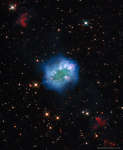 Jets from the Necklace Nebula
18.05.2021
What celestial body wears the Necklace Nebula? First, analyses indicate that the Necklace is a planetary nebula, a gas cloud emitted by a star toward the end of its life. Also, what appears to be diamonds in the Necklace are actually bright knots of glowing gas.
 APOD: 2025 September 6 Б Sardinia Sunset
6.09.2025
When the sun sets on September 7, the Full Moon will rise. And on that date denizens around much of our fair planet, including parts of Antarctica, Australia, Asia, Europe, and Africa can witness a total lunar eclipse, with the Moon completely immersed in Earth's shadow.
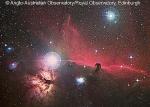 Orion's Horsehead Nebula
27.08.2000
The Horsehead Nebula is one of the most famous nebulae on the sky. It is visible as the black indentation to the red emission nebula seen just to the right of center of the above photograph. The bright star near the center is located in the belt of the familiar constellation of Orion.
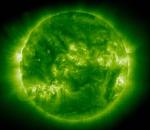 The Iron Sun
29.09.2001
The ultraviolet light emitted by eleven times ionized iron at temperatures over 2 million degrees Farenheit was used to record the above picture of the Sun on September 22, the date of the autumnal equinox.
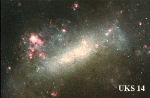 The Large Cloud Of Magellan (LMC)
24.01.1998
Ferdinand Magellan and his crew had plenty of time to study the southern sky during their famous voyage around the world. As a result, two fuzzy cloud-like objects, not visible to northern hemisphere dwellers, are now known as the Clouds of Magellan.
 Comet NEAT (Q4) Over Indian Cove
18.05.2004
Comet NEAT (Q4) was quite photogenic earlier this month. Although the head and part of the tails of Comet C/2001 Q4 (NEAT) were visible to the unaided eye, the best views of the colorful tail were revealed only later by cameras able to expose for long periods.
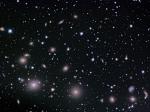 The Perseus Cluster of Galaxies
25.10.2004
Here is one of the largest objects that anyone will ever see on the sky. Each of the fuzzy blobs in the above picture is a galaxy, together making up the Perseus Cluster, one of the closest clusters of galaxies.
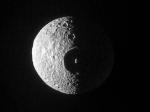 Crater on Mimas
8.03.2005
Whatever hit Mimas nearly destroyed it. What remains is one of the largest impact craters on one of Saturn's smallest moons. The crater, named Herschel after the 1789 discoverer of Mimas, Sir William Herschel, spans about 130 kilometers and is pictured above in the dramatic light of its terminator.
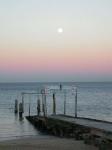 The Belt of Venus over Elwood Beach
9.08.2005
Although you've surely seen it, you might not have noticed it. During a cloudless twilight, just before sunrise or after sunset, part of the atmosphere above the horizon appears slightly off-color, slightly pink.
|
January February March April May June July August September October |
|||||||||||||||||||||||||||||||||||||||||||||||||