
|
You entered: light
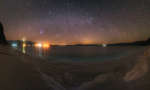 Sky Panorama Over Lake Salda
22.04.2009
As midnight approached, a spectacular sky appeared. Such was the case last month from the shore of Lake Salda in southwestern Turkey. In the above night sky panorama, rocky sand covers the foreground, while building lights are visible across the lake.
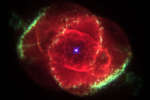 The Cats Eye Nebula
27.12.2009
Three thousand light-years away, a dying star throws off shells of glowing gas. This image from the Hubble Space Telescope reveals the Cat's Eye Nebula to be one of the most complex planetary nebulae known.
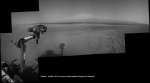 Curiosity on Mars: Mt Sharp in View
27.08.2012
What's that on the horizon? The light peak is Mt. Sharp -- an eventual destination of the Curiosity rover. The above image mosaic was taken from Bradbury Landing, the landing spot of Curiosity, and shows in the foreground the rover's extended robotic arm.
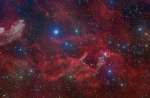 NGC 1788 and the Witch s Whiskers
19.04.2013
This skyscape finds an esthetic balance of interstellar dust and gas residing in the suburbs of the nebula rich constellation of Orion. Reflecting the light of bright star Rigel, Beta Orionis, the jutting, bluish chin of the Witch Head Nebula is at the upper left.
 A Luminous Night
9.08.2014
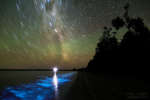
What shines in the world at night? Just visible to the eye, a rare electric blue glow spread along the shores of Victoria Lake on January 16, 2013. Against reflections of a light near the horizon, this digitally stacked long exposure recorded the bioluminescence of noctiluca scintillans, plankton stimulated by the lapping waves.
 Methane Bubbles Frozen in Lake Baikal
18.12.2018
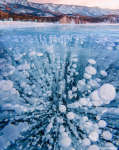
What are these bubbles frozen into Lake Baikal? Methane. Lake Baikal, a UNESCO World Heritage Site in Russia, is the world's largest (by volume), oldest, and deepest lake, containing over 20% of the world's fresh water.
 Markarians Chain of Galaxies
31.03.2019
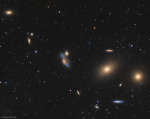
Across the heart of the Virgo Cluster of Galaxies lies a striking string of galaxies known as Markarian's Chain. The chain, pictured here, is highlighted on the right with two large but featureless lenticular galaxies, M84 and M86. Prominent to their lower left is a pair of interacting galaxies known as The Eyes.
 APOD: 2025 April 22 Б Terminator Moon: A Moonscape of Shadows
22.04.2025
What's different about this Moon? It's the terminators. In the featured image, you can't directly see any terminator -- the line that divides the light of day from the dark of night. That's because the featured image is a digital composite of many near-terminator lunar strips over a full Moon.
 A Gallery of Gravitational Mirages
1.06.1999
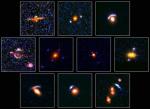
The deeper you peer into the universe, the harder it is to see straight. The reason is that distant galaxies act as gravitational lenses, deflecting light that passes nearby. These deflections result in the distortion of background sources, and in some cases the creation of multiple images.
 HR 4796A: A Recipe for Planets
22.04.1998
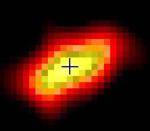
Two hundred and twenty light years from Earth, planets are forming. Recent observations of the binary star system HR 4796 have shown that one of the stars is surrounded by a dusty gaseous disk. This disk is of the right size, age, and density for dust pellets to accrete surrounding matter.
|
January February March April May June July August September October |
|||||||||||||||||||||||||||||||||||||||||||||||||