
|
You entered: light
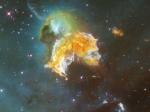 Rampaging Supernova Remnant N63A
8.06.2005
What has this supernova left behind? As little as 2,000 years ago, light from a massive stellar explosion in the Large Magellanic Clouds (LMC) first reached planet Earth. The LMC is a close...
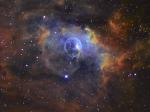 NGC 7635: The Bubble Nebula
7.11.2005
It's the bubble versus the cloud. NGC 7635, the Bubble Nebula, is being pushed out by the stellar wind of massive central star BD+602522. Next door, though, lives a giant molecular cloud, visible above to the lower right.
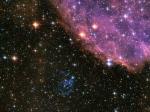 Supernova Remnant E0102 from Hubble
29.08.2006
It's the blue wisp near the bottom that's the remnant of a tremendous recent supernova explosion. The large pink structure looming to the upper right is part of N76, a large star forming region in our neighboring Small Magellanic Cloud (SMC) galaxy. The supernova remnant wisp, with full coordinate name 1E0102.
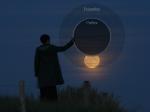 Shadow Play
9.09.2006
During September 7th's lunar eclipse, the Moon slid through the Earth's shadow. Extending into space, Earth's cone-shaped shadow has two distinct parts, the lighter, outer part or penumbra, and the darker, inner shadow called the umbra. For this eclipse, the lunar disk just grazed the shadow's dark inner umbra.
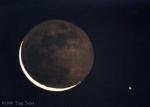 Mercury And The Moon
11.11.1999
Mercury is the closest planet to the Sun and never moves far from our parent star in Earth's sky. Racing around its tight orbit, this well-done world is a little over 1/3 the diameter of Earth and is often lost to our view in the solar glare.
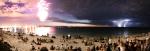 Comet Between Fireworks and Lightning
5.02.2007
Sometimes the sky itself is the best show in town. On January 26, people from Perth, Australia gathered on a local beach to watch a sky light up with delights near and far. Nearby, fireworks exploded as part of Australia Day celebrations. On the far right, lightning from a thunderstorm flashed in the distance.
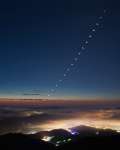 Moon Meets Morning Star
24.08.2012
Rising in the dark hours before dawn, wandering Venus now shines as the brilliant morning star. Its close conjunction with the Moon on August 13 was appreciated around planet Earth. But skygazers in eastern...
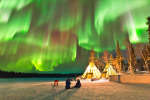 Auroras over Northern Canada
14.07.2014
Gusting solar winds and blasts of charged particles from the Sun resulted in several rewarding nights last December for those anticipating auroras. The above image captured dramatic auroras stretching across a sky near the town of Yellowknife in northern Canada.
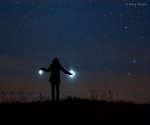 APOD: 2023 March 6 Б Jupiter and Venus from Earth
6.03.2023
It was visible around the world. The sunset conjunction of Jupiter and Venus in 2012 was visible almost no matter where you lived on Earth. Anyone on the planet with a clear western horizon at sunset could see them.
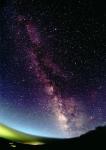 Heaven on Earth
6.11.2000
If sometimes it appears that the entire Milky Way Galaxy is raining down on your head, do not despair. It happens twice a day. As the Sun rises in the East, wonders of the night sky become less bright than the sunlight scattered by our own Earth's atmosphere, and so fade from view.
|
January February March April May June July August September October |
|||||||||||||||||||||||||||||||||||||||||||||||||