
|
You entered: dust
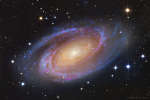 Bright Spiral Galaxy M81
18.11.2014
One of the brightest galaxies in planet Earth's sky is similar in size to our Milky Way Galaxy: big, beautiful M81. This grand spiral galaxy can be found toward the northern constellation of the Great Bear (Ursa Major).
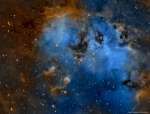 The Tadpoles of IC 410
24.01.2018
This telescopic close-up shows off the otherwise faint emission nebula IC 410. It also features two remarkable inhabitants of the cosmic pond of gas and dust below and left of center, the tadpoles of IC 410. Partly obscured by foreground dust, the nebula itself surrounds NGC 1893, a young galactic cluster of stars.
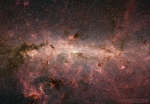 The Galactic Center in Infrared
19.04.2021
What does the center of our galaxy look like? In visible light, the Milky Way's center is hidden by clouds of obscuring dust and gas. But in this stunning vista, the Spitzer Space Telescope's infrared cameras, penetrate much of the dust revealing the stars of the crowded galactic center region.
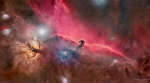 The Horsehead Nebula Region without Stars
29.08.2022
The famous Horsehead Nebula in Orion is not alone. A deep exposure shows that the dark familiar shaped indentation, visible just right of center, is part of a vast complex of absorbing dust and glowing gas.
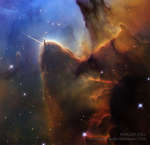 APOD: 2026 May 3 Б Trifid Pillars and Jets
3.05.2026
Dust pillars are like interstellar mountains. They survive because they are more dense than their surroundings, but they are slowly being eroded away by a hostile environment. Visible in the featured picture...
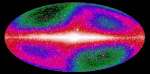 Stars in the Infrared Sky
18.09.1996
What if you could see infrared light? Because this light is less absorbed by dust than visible light, you could peer into the center of our Milky Way Galaxy. The stars there are normally hidden from direct view by the interstellar dust clouds which line the Galactic plane.
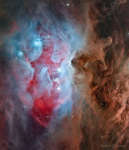 APOD: 2026 February 2 Б Orion: The Running Man Nebula
2.02.2026
What part of Orion is this? Just north of the famous Orion Nebula is a picturesque star forming region in Orion's Sword that contains a lot of intricate dust -- some of which appears blue because it reflects the light of bright embedded stars.
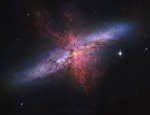 M82: Galaxy with a Supergalactic Wind
23.07.2019
Why is the Cigar Galaxy billowing red smoke? M82, as this starburst galaxy is also known, was stirred up by a recent pass near large spiral galaxy M81. This doesn't fully explain the source of the red-glowing outwardly expanding gas and dust, however.
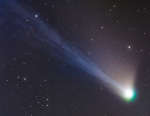 Tails of Comet Lemmon
6.05.2013
What caused the interestingly intricate tails that Comet Lemmon displayed earlier this year? First of all, just about every comet that nears the Sun displays two tails: a dust tail and an ion tail.
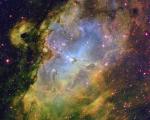 Inside the Eagle Nebula
11.06.2002
From afar, the whole thing looks like an Eagle. A closer look of the Eagle Nebula, however, shows the bright region is actually a window into the center of a larger dark shell of dust. Through this window, a brightly-lit workshop appears where a whole open cluster of stars is being formed.
|
January February March April May June July August September October |
|||||||||||||||||||||||||||||||||||||||||||||||||