
|
You entered: dust
 NGC 7023: The Iris Nebula
25.07.2024
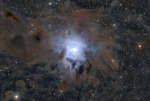
These cosmic clouds have blossomed 1,300 light-years away in the fertile starfields of the constellation Cepheus. Called the Iris Nebula, NGC 7023 is not the only nebula to evoke the imagery of flowers.
 NGC 7023: The Iris Nebula
16.01.2026
These cosmic clouds have blossomed 1,300 light-years away in the fertile starfields of the constellation Cepheus. Called the Iris Nebula, NGC 7023 is not the only nebula to evoke the imagery of flowers.
 The Orion Nebula from VLT
30.01.2001
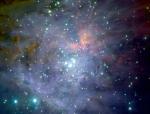
The Great Nebula in Orion is a colorful place. Visible to the unaided eye, it appears as a small fuzzy patch in the constellation of Orion. But this image, a representative-color composite...
 Inside the Eagle Nebula
21.09.2003
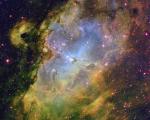
From afar, the whole thing looks like an Eagle. A closer look of the Eagle Nebula, however, shows the bright region is actually a window into the center of a larger dark shell of dust. Through this window, a brightly-lit workshop appears where a whole open cluster of stars is being formed.
 NGC 281: Cluster, Clouds, and Globules
21.09.1998
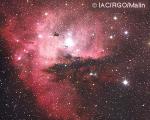
NGC 281 is a busy workshop of star formation. Prominent features include a small open cluster of stars, a diffuse red-glowing emission nebula, large lanes of obscuring gas and dust, and dense knots of dust and gas in which stars may still be forming.
 APOD: 2023 November 27 Б LBN 86: The Eagle Ray Nebula
27.11.2023
This eagle ray glides across a cosmic sea. Officially cataloged as SH2-63 and LBN 86, the dark nebula is composed of gas and dust that just happens to appear shaped like a common ocean fish. The interstellar dust nebula appears light brown as it blocks and reddens visible light emitted behind it.
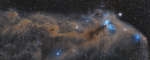 Across Corona Australis
29.11.2018
Cosmic dust clouds are draped across a rich field of stars in this broad telescopic panorama near the northern boundary of Corona Australis, the Southern Crown. Less than 500 light-years away the denser clouds effectively block light from more distant background stars in the Milky Way.
 APOD: 2023 August 2 Б M82: Galaxy with a Supergalactic Wind
2.08.2023
Why is the Cigar Galaxy billowing red smoke? M82, as this starburst galaxy is also known, was stirred up by a recent pass near large spiral galaxy M81. This doesn't fully explain the source of the red-glowing outwardly expanding gas and dust, however.
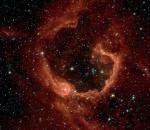 RCW 79: Stars in a Bubble
15.04.2005
A cosmic bubble of gas and dust, RCW 79 has grown to about 70 light-years in diameter, blown by the winds and radiation from hot young stars. Infrared light from the dust embedded in the nebula is tinted red in this gorgeous false-color view from the Spitzer Space Telescope.
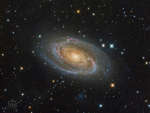 Messier 81
17.04.2019
One of the brightest galaxies in planet Earth's sky is similar in size to our Milky Way Galaxy: big, beautiful Messier 81. Also known as NGC 3031 or Bode's galaxy for its 18th century discoverer, this grand spiral can be found toward the northern constellation of Ursa Major, the Great Bear.
|
January February March April May June July August September October |
|||||||||||||||||||||||||||||||||||||||||||||||||