
|
You entered: phase
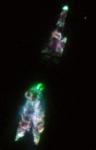 Emerging Planetary Nebula CRL 618
6.09.2000
CRL 618 may look to some like an Olympian declaring victory. Only a few hundred years ago, however, CRL 618 appeared as a relatively modest red giant star. Since then it has run out of core material to fuse and so has started to become a planetary nebula.
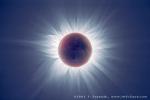 Moon AND Sun
21.11.2003
This composite image was made from 22 separate pictures of the Moon and Sun all taken from Chisamba, Zambia during the total phase of the 2001 June 21 solar eclipse. The multiple exposures were...
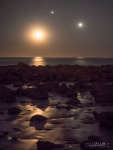 Triple Conjunction Over Galician National Park
23.06.2015
What are those bright objects hovering over the horizon? Planets -- and the Moon. First out, the horizon featured is a shoreline of the Atlantic Ocean that occurs at the Galicia National Park in northern Spain. Next furthest out, on the left, is the Moon.
 Solar Eclipse from Western Australia
20.04.2023
Along a narrow path that mostly avoided landfall, the shadow of the New Moon raced across planet Earth's southern hemisphere on April 20 to create a rare annular-total or hybrid solar eclipse.
 Full Moons of August
29.08.2023
Near perigee, the closest point in its almost moonthly orbit, a Full Moon rose as the Sun set on August 1. Its brighter than average lunar disk was captured in this dramatic moonrise sequence over dense cloud banks along the eastern horizon from Ragusa, Sicily.
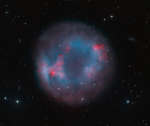 Planetary Nebula Abell 7
22.01.2026
Very faint planetary nebula Abell 7 is about 1,800 light-years distant. It lies just south of Orion in planet Earth's skies toward the constellation Lepus, The Hare. Posing with scattered Milky Way stars, its generally simple spherical shape about 8 light-years in diameter is revealed in this deep telescopic image.
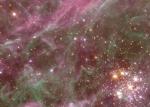 Denizen of the Tarantula Nebula
7.04.1999
The star cluster at lower right, cataloged as Hodge 301, is a denizen of the Tarantula Nebula. An evocative nebula in the southern sky, the sprawling cosmic Tarantula is an energetic star forming region some 168,000 light-years distant in our neighboring galaxy the Large Magellanic Cloud.
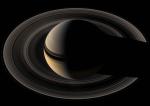 Crescent Saturn
23.10.2007
Saturn never shows a crescent phase -- from Earth. But when viewed from beyond, the majestic giant planet can show an unfamiliar diminutive sliver. This image of crescent Saturn in natural color was taken by the robotic Cassini spacecraft in May.
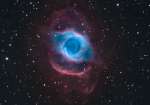 NGC 7293: The Helix Nebula
4.10.2012
A mere seven hundred light years from Earth, in the constellation Aquarius, a sun-like star is dying. Its last few thousand years have produced the Helix Nebula (NGC 7293), a well studied and nearby example of a Planetary Nebula, typical of this final phase of stellar evolution.
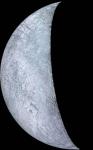 Crescent Europa
24.02.2002
Although the phase of this moon might appear familiar, the moon itself might not. In fact, this crescent shows part of Jupiter's moon Europa. The passing robot spacecraft Voyager 2 captured this image in 1979.
|
January February March April May June July August |
||||||||||||||||||||||||||||||||||||||||||||||||||||||||