
|
You entered: phase
 Lunations
12.09.2018
Our Moon's appearance changes nightly. As the Moon orbits the Earth, the half illuminated by the Sun first becomes increasingly visible, then decreasingly visible. The featured video animates images taken by NASA's Moon-orbiting Lunar Reconnaissance Orbiter to show all 12 lunations that appear this year, 2018.
 APOD: 2025 May 14 Б NGC 1360: The Robins Egg Nebula
14.05.2025
This pretty nebula lies some 1,500 light-years away, its shape and color in this telescopic view reminiscent of a robin's egg. The cosmic cloud spans about 3 light-years, nestled securely within the boundaries of the southern constellation of the Furnace (Fornax).
 Ring of Fire Revisited
30.05.2003
Early on Saturday, May 31 (UT) the new Moon will once again slide across the Sun's fiery disk, and once again an annular solar eclipse will be the result -- since the Moon's apparent diameter will be a little too small to completely cover the Sun.
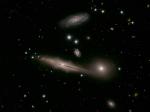 Galaxy Group HCG 87
16.07.2005
Posing for this cosmic family photo are the galaxies of HCG (Hickson Compact Group) 87, about four hundred million light-years distant toward the amphibious constellation Capricornus. The large edge-on spiral near picture center...
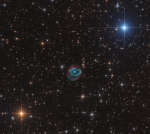 Planetary Nebula Abell 78
16.10.2020
Planetary nebula Abell 78 stands out in this colorful telescopic skyscape. In fact the colors of the spiky Milky Way stars depend on their surface temperatures, both cooler (yellowish) and hotter (bluish) than the Sun.
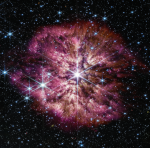 Wolf Rayet 124
18.03.2023
Driven by powerful stellar winds, expanding shrouds of gas and dust frame hot, luminous star Wolf-Rayet 124 in this sharp infrared view. The eye-catching 6-spike star pattern is characteristic of stellar images made with the 18 hexagonal mirrors of the James Webb Space Telescope.
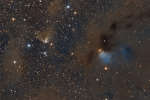 Dusty Nebulae in Taurus
11.07.2013
This complex of dusty nebulae linger along the edge of the Taurus molecular cloud, a mere 450 light-years distant. Stars are forming on the cosmic scene, including extremely youthful star RY Tauri prominent toward the upper left of the 1.5 degree wide telescopic field.
 A Colourful Moon
11.11.2017
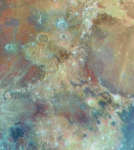
The Moon is normally seen in subtle shades of grey. But small, measurable color differences have been greatly exaggerated in this mosaic of high-resolution images captured near the Moon's full phase, to construct a multicolored, central moonscape.
 APOD: 2026 February 25 Б The Egg Nebula from the Hubble Telescope
25.02.2026
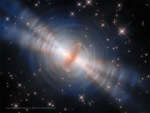
Ever wonder what it would look like to crack open the Sun? The Egg Nebula, a dying Sun-like star, can unscramble this question. Pictured is a combination of several visible and infrared images of the nebula (also known as RAFGL 2688 or CRL 2688) taken with the Hubble Space Telescope.
 Zubenelgenubi and Friends
14.05.2004
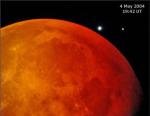
Moderately bright Zubenelgenubi is the star just off the upper right hand limb of an eclipsed Moon in this telescopic view from Port Elizabeth, South Africa. Actually the second brightest star in the constellation...
|
January February March April May June July August |
||||||||||||||||||||||||||||||||||||||||||||||||||||||||