
|
You entered: NASA
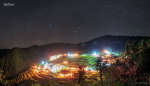 Dark Skies: Turn on the Night
16.05.2019
Have you ever experienced a really dark night sky? One common and amazing feature is the glowing band of our Milky Way galaxy stretching from horizon to horizon. If you live in or near...
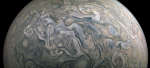 Churning Clouds on Jupiter
11.08.2020
Where is Jupiter's ammonia? Gaseous ammonia was expected to be seen in Jupiter's upper atmosphere by the orbiting Juno spacecraft -- but in many clouds is almost absent. Recent Juno data, however, gives some clues: some high-level clouds appear to be home to an unexpected type of electrical discharge dubbed shallow lightning.
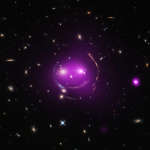 Gravity s Grin
11.05.2022
Albert Einstein's general theory of relativity, published over 100 years ago, predicted the phenomenon of gravitational lensing. And that's what gives these distant galaxies such a whimsical appearance, seen through the looking glass of X-ray and optical image data from the Chandra and Hubble space telescopes.
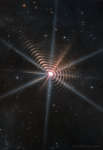 Dust Shells around WR 140 from Webb
13.10.2022
What are those strange rings? Rich in dust, the rings are likely 3D shells -- but how they were created remains a topic of research. Where they were created is well known: in a binary...
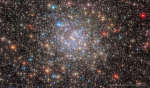 APOD: 2023 January 30 Б Globular Star Cluster NGC 6355 from Hubble
30.01.2023
Globular clusters once ruled the Milky Way. Back in the old days, back when our Galaxy first formed, perhaps thousands of globular clusters roamed our Galaxy. Today, there are less than 200 left. Over the eons, many globular clusters were destroyed by repeated fateful encounters with each other or the Galactic center.
 APOD: 2024 August 28 Б Tulip Nebula and Black Hole Cygnus X 1
28.08.2024
When can you see a black hole, a tulip, and a swan all at once? At night -- if the timing is right, and if your telescope is pointed in the right direction. The complex and beautiful Tulip Nebula blossoms about 8,000 light-years away toward the constellation of Cygnus the Swan.
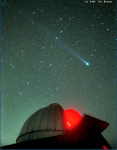 Hyakutake, Big Dipper, and Observatory Dome
1.04.1996
In one of the more spectacular pictures yet taken, Comet Hyakutake is shown here on March 26 high in the dark Missouri sky. In the foreground is Elmcrest Observatory complete with a dim red light glowing inside the dome.
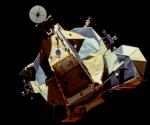 Apollo 17 s Moonship
7.01.2006
Awkward and angular looking, Apollo 17's lunar module Challenger was designed for flight in the vacuum of space. This picture from command module America, shows Challenger's ascent stage in lunar orbit. Small reaction control thrusters are at the sides of the moonship with the bell of the ascent rocket engine underneath.
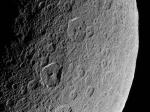 Ancient Craters on Saturns Rhea
30.05.2006
Saturn's ragged moon Rhea has one of the oldest surfaces known. Estimated as changing little in the past billion years, Rhea shows craters so old they no longer appear round their edges have become compromised by more recent cratering.
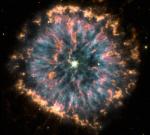 Celebrating Hubble With NGC 6751
7.04.2000
Planetary nebulae do look simple, round, and planet-like in small telescopes. But images from the orbiting Hubble Space Telescope have become well known for showing these fluorescent gas shrouds of dying Sun-like stars to possess a staggering variety of detailed symmetries and shapes.
|
January February March April May June July August September October |
|||||||||||||||||||||||||||||||||||||||||||||||||