
|
You entered: NASA
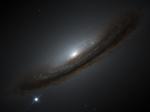 Rumors of a Strange Universe
24.12.2006
Eight years ago results were first presented indicating that most of the energy in our universe is not in stars or galaxies but is tied to space itself. In the language of cosmologists, a large cosmological constant is directly implied by new distant supernovae observations.
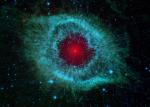 APOD: 2007 February 23- Dust and the Helix Nebula
23.02.2007
Dust makes this cosmic eye look red. The eerie Spitzer Space Telescope image shows infrared radiation from the well-studied Helix Nebula (NGC 7293) a mere 700 light-years away in the constellation Aquarius.
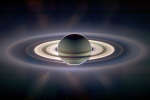 In the Shadow of Saturn
11.01.2009
In the shadow of Saturn, unexpected wonders appear. The robotic Cassini spacecraft now orbiting Saturn recently drifted in giant planet's shadow for about 12 hours and looked back toward the eclipsed Sun. Cassini saw a view unlike any other.
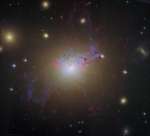 Hubble Remix: Active Galaxy NGC 1275
4.06.2010
Active galaxy NGC 1275 is the central, dominant member of the large and relatively nearby Perseus Cluster of Galaxies. Wild-looking at visible wavelengths, the active galaxy is also a prodigious source of x-rays and radio emission.
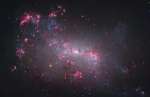 NGC 4449: Close up of a Small Galaxy
25.02.2011
Grand spiral galaxies often seem to get all the glory. Their young, blue star clusters and pink star forming regions along sweeping spiral arms are guaranteed to attract attention. But small irregular galaxies form stars too, like NGC 4449, about 12 million light-years distant.
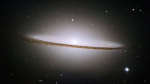 The Sombrero Galaxy from Hubble
15.05.2011
What's going on in the center of this spiral galaxy? Named the Sombrero Galaxy for its hat-like resemblance, M104 features a prominent dust lane and a bright halo of stars and globular clusters.
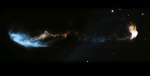 HH 47: A Young Star Jet Expands
5.09.2011
Stars remain where they are. Nebulas appear the same. Day after day. Year after year. Given the vast distances in astronomy, even fast moving objects will not appear to change their appearance in a human lifetime. Typically. A recent spectacular exception to this, however, is the supersonic jet in the star forming Herbig Haro 47.
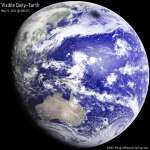 Looking Back at an Eclipsed Earth
30.05.2012
What's that dark spot on planet Earth? It's the shadow of the Moon. The above image of Earth was taken last week by MTSAT during an annular eclipse of the Sun. The dark spot appears quite unusual as clouds are white and the oceans are blue in this color corrected image.
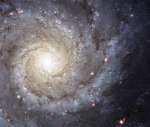 M74: The Perfect Spiral
11.08.2013
If not perfect, then this spiral galaxy is at least one of the most photogenic. An island universe of about 100 billion stars, 32 million light-years away toward the constellation Pisces, M74 presents a gorgeous face-on view.
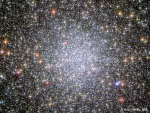 Globular Star Cluster 47 Tuc
19.05.2015
Globular star cluster 47 Tucanae is a jewel box of the southern sky. Also known as NGC 104, it roams the halo of our Milky Way Galaxy along with over 150 other globular star clusters.
|
January February March April May June July August September October |
|||||||||||||||||||||||||||||||||||||||||||||||||