
|
You entered: life
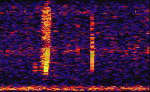 The Bloop: A Mysterious Sound from the Deep Ocean
27.04.2010
What created this strange sound in Earth's Pacific Ocean? Pictured above is a visual representation of a loud and unusual sound, dubbed a Bloop, captured by deep sea microphones in 1997. In the above graph, time is shown on the horizontal axis, deep pitch is shown on the vertical axis, and brightness designates loudness.
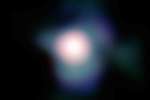 Betelgeuse Resolved
5.08.2009
The sharpest image ever of Betelgeuse shows a mammoth star that is slowly evaporating. Betelgeuse (sounds a lot like "beetle juice"), also known as Alpha Orionis, is one of the largest and brightest stars known. The star is a familiar orange fixture easily visible to the unaided eye toward the constellation of Orion.
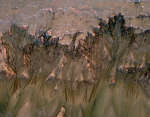 Seasonal Dark Streaks on Mars
8.08.2011
What is causing these dark streaks on Mars? A leading hypothesis is flowing -- but quickly evaporating -- water. The streaks, visible in dark brown near the image center, appear in the Martian spring and summer but fade in the winter months, only to reappear again the next summer.
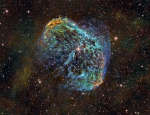 NGC 6888: The Crescent Nebula
16.08.2012
NGC 6888, also known as the Crescent Nebula, is a cosmic bubble about 25 light-years across, blown by winds from its central, bright, massive star. This colorful portrait of the nebula uses narrow band image data combined in the Hubble palatte.
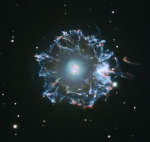 Halo of the Cat s Eye
20.10.2018
Not a Falcon 9 rocket launch after sunset, the Cat's Eye Nebula (NGC 6543) is one of the best known planetary nebulae in the sky. Its haunting symmetries are seen in the very...
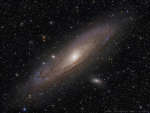 Andromeda Island Universe
30.04.2020
The most distant object easily visible to the unaided eye is M31, the great Andromeda Galaxy some two and a half million light-years away. But without a telescope, even this immense spiral galaxy - spanning over 200,000 light years - appears as a faint, nebulous cloud in the constellation Andromeda.
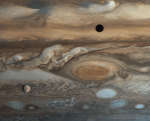 Europa and Jupiter from Voyager 1
28.06.2020
What are those spots on Jupiter? Largest and furthest, just right of center, is the Great Red Spot -- a huge storm system that has been raging on Jupiter possibly since Giovanni Cassini's likely notation of it 355 years ago. It is not yet known why this Great Spot is red.
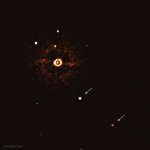 APOD: 2020 August 18 Б TYC 8998 760 1: Multiple Planets around a Sun Like Star
18.08.2020
Do other stars have planets like our Sun? Previous evidence shows that they do, coming mostly from slight shifts in the star's light created by the orbiting planets. Recently, however, and for the first time, a pair of planets has been directly imaged around a Sun-like star.
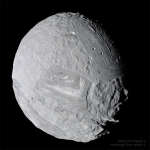 APOD: 2026 February 9 Б Miranda Revisited
9.02.2026
What is Miranda really like? Visually, old images from NASA's Voyager 2 have been recently combined and remastered to result in the featured image of Uranus's 500-kilometer-wide moon. In the late 1980s...
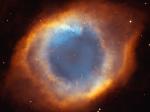 NGC 7293: The Helix Nebula
10.05.2003
Will our Sun look like this one day? The Helix Nebula is the closest example of a planetary nebula created at the end of the life of a Sun-like star. The outer gasses of the star expelled into space appear from our vantage point as if we are looking down a helix.
|
January February March April May June July August September October |
|||||||||||||||||||||||||||||||||||||||||||||||||