
|
You entered: life
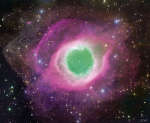 The Helix Nebula from CFHT
3.01.2018
Will our Sun look like this one day? The Helix Nebula is one of brightest and closest examples of a planetary nebula, a gas cloud created at the end of the life of a Sun-like star.
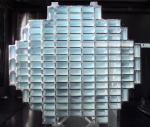 Aerogel For Stardust
18.02.1999
On February 7th, this honey comb of aluminum cells filled with aerogel was launched on the STARDUST mission to interplanetary space. STARDUST's goal is to capture dust from a comet's tail and return to planet Earth - the first sample return mission to a comet!
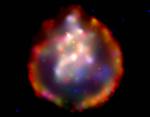 SNR 0103 72.6: Oxygen Supply
13.08.2005
A supernova explosion, a massive star's inevitable and spectacular demise, blasts back into space debris enriched in the heavy elements forged in its stellar core. Incorporated into future stars and planets, these are the elements ultimately necessary for life. Seen here in a false-color x-ray image, supernova remnant SNR 0103-72
 A Bubble in Cygnus
13.11.2008
Adrift in the rich star fields of the constellation Cygnus, this lovely, symmetric bubble nebula was only recently recognized and may not yet appear in astronomical catalogs. In fact, amateur astronomer Dave Jurasevich identified...
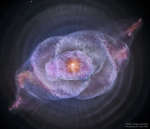 The Cats Eye Nebula in Optical and Xray
1.05.2019
To some it looks like a cat's eye. To others, perhaps like a giant cosmic conch shell. It is actually one of brightest and most highly detailed planetary nebula known, composed of gas expelled in the brief yet glorious phase near the end of life of a Sun-like star.
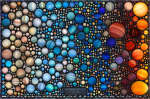 APOD: 2024 July 8 Б Exoplanet Zoo: Other Stars
8.07.2024
Do other stars have planets like our Sun? Surely they do, and evidence includes slight star wobbles created by the gravity of orbiting exoplanets and slight star dimmings caused by orbiting planets moving in front.
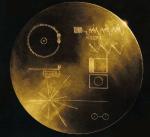 The Voyagers' Message in a Bottle
31.08.2002
Launched twenty-five years ago, NASA's Voyager 1 and 2 spacecraft are now over 10 billion kilometers from the Sun. Still operational, the Voyagers are being tracked and commanded through the Deep Space Network.
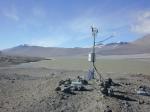 The Lost World of Lake Vida
28.01.2003
A lake hidden beneath 19 meters of ice has been found near the bottom of the world that might contain an ecosystem completely separate from our own. In a modern version of Sir Arthur...
 Springtime Comet Fever
20.03.1997
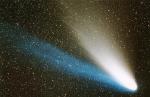
Today marks the Vernal Equinox, the first day of Spring for planet Earth's northern hemisphere. Despite recent attempts by other spectacular and dramatic celestial events to take center stage, Comet Hale-Bopp remains the most popular object in the sky (according to APOD access logs!) and is likely to make this spring memorable for many.
 Supernova Remnant and Shock Wave
17.02.2006
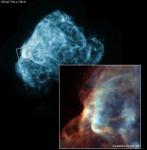
A massive star ends life as a supernova, blasting its outer layers back to interstellar space. The spectacular death explosion is initiated by the collapse of what has become an impossibly dense stellar core. Pictured is the expanding supernova remnant Puppis A - one of the brightest sources in the x-ray sky.
|
January February March April May June July August September October |
|||||||||||||||||||||||||||||||||||||||||||||||||