
|
You entered: life
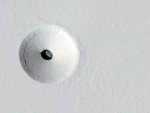 A Hole in Mars
18.07.2012
What created this unusual hole in Mars? The hole was discovered by chance on images of the dusty slopes of Mars' Pavonis Mons volcano taken by the HiRISE instrument aboard the robotic Mars Reconnaissance Orbiter currently circling Mars. The hole appears to be an opening to an underground cavern, partly illuminated on the image right.
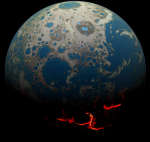 Four Billion BCE: Battered Earth
5.08.2014
No place on Earth was safe. Four billion years ago, during the Hadean eon, our Solar System was a dangerous shooting gallery of large and dangerous rocks and ice chunks. Recent examination of lunar...
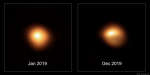 The Changing Surface of Fading Betelgeuse
17.02.2020
Besides fading, is Betelgeuse changing its appearance? Yes. The famous red supergiant star in the familiar constellation of Orion is so large that telescopes on Earth can actually resolve its surface -- although just barely.
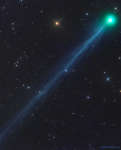 The Ion Tail of New Comet SWAN
29.04.2020
Newly discovered Comet SWAN has already developed an impressive tail. The comet came in from the outer Solar System and has just passed inside the orbit of the Earth. Officially designated C/2020 F8 (SWAN)...
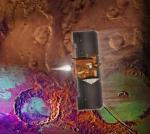 Odyssey at Mars
25.10.2001
After an interplanetary journey lasting 200 days, the Mars Odyssey spacecraft has entered orbit around the Red Planet. This latest success is welcome as in the past, Mars has often seemed a difficult planet to visit.
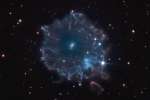 Halo of the Cat s Eye
31.08.2012
The Cat's Eye Nebula (NGC 6543) is one of the best known planetary nebulae in the sky. Its haunting symmetries are seen in the very central region of this tantalizing image, processed to reveal the enormous but extremely faint halo of gaseous material, about 6 light-years across, which surrounds the brighter, familiar planetary nebula.
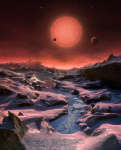 Three Worlds for TRAPPIST 1
7.05.2016
Three new found worlds orbit the ultracool dwarf star TRAPPIST-1, a mere 40 light-years away. Their transits were first detected by the Belgian robotic TRAnsiting Planets and Planetesimals Small Telescope, TRAPPIST, at ESO's La Silla Observatory in Chile. The newly discovered exoplanets are all similar in size to Earth.
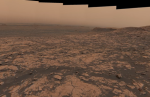 Curiosity Vista from Vera Rubin Ridge
10.09.2018
If you could stand on Mars -- what might you see? If you were NASA's Curiosity rover, just last month you would have seen the view from Vera Rubin Ridge, an intriguing rock-strewn perch on the side of Mount Sharp.
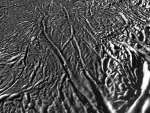 Close Up of Enceladus Tiger Stripes
31.03.2008
Could life exist beneath Enceladus? A recent flyby of Saturn's icy moon has bolstered this fascinating idea. Two years ago, images from the robotic Cassini spacecraft orbiting Saturn led astronomers to the undeniable...
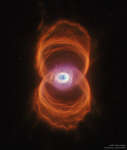 MyCn 18: The Engraved Hourglass Planetary Nebula
29.09.2019
Do you see the hourglass shape -- or does it see you? If you can picture it, the rings of MyCn 18 trace the outline of an hourglass -- although one with an unusual eye in its center. Either way, the sands of time are running out for the central star of this hourglass-shaped planetary nebula.
|
January February March April May June July August September October |
|||||||||||||||||||||||||||||||||||||||||||||||||