
|
You entered: nebula
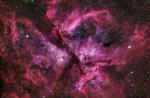 The Great Carina Nebula
27.10.2007
A jewel of the southern sky, the Great Carina Nebula, aka NGC 3372, spans over 300 light-years, one of our galaxy's largest star forming regions. Like the smaller, more northerly Orion Nebula...
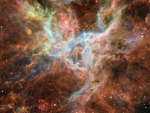 In the Heart of the Tarantula Nebula
31.03.2009
In the heart of monstrous Tarantula Nebula lies huge bubbles of energetic gas, long filaments of dark dust, and unusually massive stars. In the center of this heart, is a knot of stars so dense that it was once thought to be a single star.
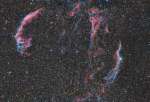 Wisps of the Veil Nebula
26.11.2012
Wisps like this are all that remain visible of a Milky Way star. About 9,000 years ago that star exploded in a supernova leaving the Veil Nebula, also known as the Cygnus Loop.
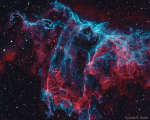 NGC 6995: The Bat Nebula
25.11.2019
Do you see the bat? It haunts this cosmic close-up of the eastern Veil Nebula. The Veil Nebula itself is a large supernova remnant, the expanding debris cloud from the death explosion of a massive star.
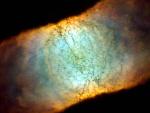 IC 4406: A Seemingly Square Nebula
18.06.2002
How can a round star make a square nebula? This conundrum comes to light when studying planetary nebulae like IC 4406. Evidence indicates that IC 4406 is likely a hollow cylinder, with its square appearance the result of our vantage point in viewing the cylinder from the side.
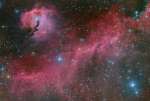 The Seagull Nebula
29.08.2015
A broad expanse of glowing gas and dust presents a bird-like visage to astronomers from planet Earth, suggesting its popular moniker - The Seagull Nebula. This portrait of the cosmic bird covers a 1.6 degree wide swath across the plane of the Milky Way, near the direction of Sirius, alpha star of the constellation Canis Major.
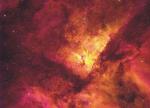 NGC 3372: The Great Nebula in Carina
19.07.1999
In one of the brightest parts of the Milky Way lies a nebula where some of the oddest things occur. NGC 3372, known as the Great Nebula in Carina, is home to massive stars and changing nebula.
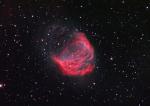 The Medusa Nebula
23.11.2007
Braided, serpentine filaments of glowing gas suggest this nebula's popular name, The Medusa Nebula. Also known as Abell 21, this Medusa is an old planetary nebula some 1,500 light-years away in the constellation Gemini. Like its mythological namesake, the nebula is associated with a dramatic transformation.
 The Medusa Nebula
25.10.2012
Braided, serpentine filaments of glowing gas suggest this nebula's popular name, The Medusa Nebula. Also known as Abell 21, this Medusa is an old planetary nebula some 1,500 light-years away in the constellation Gemini. Like its mythological namesake, the nebula is associated with a dramatic transformation.
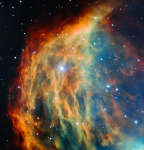 The Medusa Nebula
12.06.2015
Braided, serpentine filaments of glowing gas suggest this nebula's popular name, The Medusa Nebula. Also known as Abell 21, this Medusa is an old planetary nebula some 1,500 light-years away along the southern border of the constellation Gemini. Like its mythological namesake, the nebula is associated with a dramatic transformation.
|
January February March April May June July August |
||||||||||||||||||||||||||||||||||||||||||||||||||||||||