
|
You entered: nebula
 APOD: 2024 April 28 Б Rings Around the Ring Nebula
27.04.2024
The Ring Nebula (M57) is more complicated than it appears through a small telescope. The easily visible central ring is about one light-year across, but this remarkably deep exposure - a collaborative effort combining data from three different large telescopes - explores the looping filaments of glowing gas extending much farther from the nebula's central star.
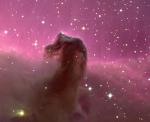 The Horsehead Nebula
19.05.1999
One of the most identifiable nebulae in the sky, the Horsehead Nebula in Orion, is part of a large, dark, molecular cloud. Also known as Barnard 33, the unusual shape was first discovered on a photographic plate in the late 1800s.
 The Great Carina Nebula
18.04.2024
A jewel of the southern sky, the Great Carina Nebula is more modestly known as NGC 3372. One of our Galaxy's largest star forming regions, it spans over 300 light-years. Like the smaller, more northerly Great Orion Nebula, the Carina Nebula is easily visible to the unaided eye.
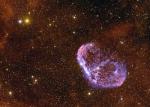 A Crescent Nebula Star Field
15.04.2003
What caused the Crescent Nebula? Looking like an emerging space cocoon, the Crescent Nebula, visible on the right, was created by the brightest star in its center. A leading progenitor hypothesis has the Crescent Nebula beginning to form about 250,000 years ago.
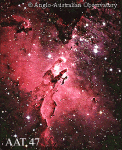 M16: Nebula With Star Cluster
17.01.1997
The photogenic M16 shown above is composed of a young star cluster associated with a spectacular emission nebulae lined with clouds of interstellar dust. The gorgeous spectacle lies toward the galactic center region, some 7,000 light years distant in the constellation Serpens.
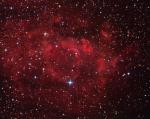 Stars and the Bubble Nebula
16.01.2003
Seemingly adrift in an cosmic sea of stars and gas, this delicate, floating apparition is cataloged as NGC 7635 -- The Bubble Nebula. In this wide-angle view, the Bubble nebula lies at the center of a larger complex of shocked glowing gas about 11,000 light-years distant in the fair constellation Cassiopeia.
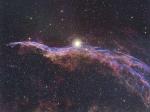 NGC 6960: The Witchs Broom Nebula
1.03.2004
Ten thousand years ago, before the dawn of recorded human history, a new light must suddenly have appeared in the night sky and faded after a few weeks. Today we know this light was an exploding star and record the colorful expanding cloud as the Veil Nebula.
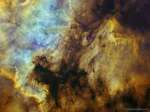 The North America and Pelican Nebulas
13.06.2016
Here lie familiar shapes in unfamiliar locations. On the left is an emission nebula cataloged as NGC 7000, famous partly because it resembles our fair planet's continent of North America. The emission region to the right of the North America Nebula is IC 5070, also known for its suggestive outlines as the Pelican Nebula.
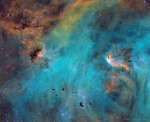 Stars and Globules in the Running Chicken Nebula
18.04.2022
The eggs from this gigantic chicken may form into stars. The featured emission nebula, shown in scientifically assigned colors, is cataloged as IC 2944 but known as the Running Chicken Nebula for the shape of its greater appearance. Seen toward the bottom of the image are small, dark molecular clouds rich in obscuring cosmic dust.
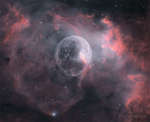 APOD: 2026 July 27 Б NGC 7635: The Bubble Nebula
26.07.2026
What created this huge space bubble? Blown by the wind from a star, this tantalizing, head-like apparition is cataloged as NGC 7635, but known simply as the Bubble Nebula. Taken from Krakow, Poland, the featured view utilizes a long exposure to reveal the intricate details of this cosmic bubble and its environment.
|
January February March April May June July August |
||||||||||||||||||||||||||||||||||||||||||||||||||||||||