
|
You entered: nebula
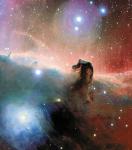 The Colorful Horsehead Nebula
7.10.2003
While drifting through the cosmos, a magnificent interstellar dust cloud became sculpted by stellar winds and radiation to assume a recognizable shape. Fittingly named the Horsehead Nebula, it is embedded in the vast and complex Orion Nebula.
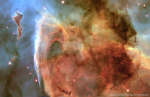 The Keyhole in the Carina Nebula
14.08.2016
The dark dusty Keyhole Nebula gets its name from its unusual shape. The looping Keyhole, in this featured classic image by the Hubble Space Telescope, is a smaller region inside the larger Carina Nebula.
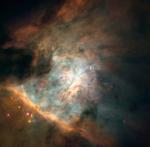 M42: A Mosaic of Orion's Great Nebula
22.05.1999
The Great Nebula in Orion, an immense, nearby starbirth region, is probably the most famous of all astronomical nebulae. Here, 15 pictures from the Hubble Space Telescope have been mosaicked to cover the inner 2.5 light years of the nebula and illustrate its diverse nature.
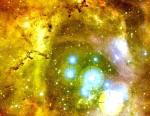 In the Center of the Rosette Nebula
29.04.2003
In the heart of the Rosette Nebula lies a bright open cluster of stars that lights up the nebula. The stars of NGC 2244 formed from the surrounding gas only a few million years ago. This just-released image taken by the CFHT's new MegaPrime camera shows the region in unprecedented detail.
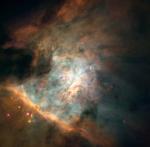 M42: A Mosaic of Orion's Great Nebula
11.05.1997
The Great Nebula in Orion, an immense, nearby starbirth region, is probably the most famous of all astronomical nebulae. Here, 15 pictures from the Hubble Space Telescope have been mosaicked to cover the inner 2.5 light years of the nebula and illustrate its diverse nature.
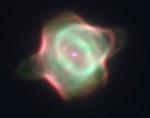 Hen 1357: New Born Nebula
6.10.2001
This Hubble Space Telescope snapshot shows Hen-1357, the youngest known planetary nebula. Graceful, gentle curves and symmetry suggest its popular name - The Stingray Nebula. Observations in the 1970s detected no nebular material, but this image from March 1996 clearly shows the Stingray's emerging bubbles and rings of shocked and ionized gas.
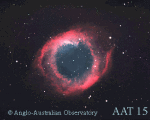 NGC 7293: The Helix Nebula
17.04.1996
The Helix nebula (New General Catalog number 7293) is estimated to be a mere 450 light-years from the Sun, in the direction of the constellation Aquarius. At that distance it may well be the closest planetary nebula, offering a dramatic snapshot of a brief final evolutionary stage in the life of a solar-type star.
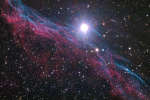 NGC 6960: The Witch s Broom Nebula
19.08.2008
Ten thousand years ago, before the dawn of recorded human history, a new light must suddenly have appeared in the night sky and faded after a few weeks. Today we know this light was an exploding star and record the colorful expanding cloud as the Veil Nebula.
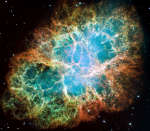 M1: The Crab Nebula from Hubble
25.12.2011
This is the mess that is left when a star explodes. The Crab Nebula, the result of a supernova seen in 1054 AD, is filled with mysterious filaments. The filaments are not only tremendously complex, but appear to have higher speed than expected from a free explosion.
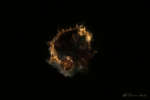 A Falcon 9 Nebula
4.09.2021
Not the Hubble Space Telescope's latest view of a distant galactic nebula, this illuminated cloud of gas and dust dazzled early morning spacecoast skygazers on August 29. The snapshot was taken at 3:17am from Space View Park in Titusville, Florida.
|
January February March April May June July August |
||||||||||||||||||||||||||||||||||||||||||||||||||||||||