
|
You entered: nebula
 IC 2574: Coddington's Nebula
6.02.2025
Grand spiral galaxies often seem to get all the glory, flaunting their young, bright, blue star clusters in beautiful, symmetric spiral arms. But small, irregular galaxies form stars too. In fact dwarf galaxy IC 2574 shows clear evidence of intense star forming activity in its telltale reddish regions of glowing hydrogen gas.
 APOD: 2024 January 23 Б Deep Nebulas: From Seagull to California
23.01.2024
How well do you know the night sky? OK, but how well can you identify famous sky objects in a very deep image? Either way, here is a test: see if you can find some well-known night-sky icons in a deep image filled with faint nebulosity.
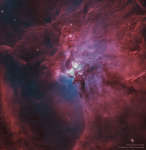 The Lively Center of the Lagoon Nebula
1.06.2020
The center of the Lagoon Nebula is a whirlwind of spectacular star formation. Visible near the image center, at least two long funnel-shaped clouds, each roughly half a light-year long, have been formed by extreme stellar winds and intense energetic starlight. A tremendously bright nearby star, Hershel 36, lights the area.
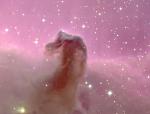 The Horsehead Nebula
13.07.2003
One of the most identifiable nebulae in the sky, the Horsehead Nebula in Orion, is part of a large, dark, molecular cloud. Also known as Barnard 33, the unusual shape was first discovered on a photographic plate in the late 1800s.
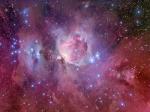 M42: Wisps of the Orion Nebula
20.11.2006
The Great Nebula in Orion, an immense, nearby starbirth region, is probably the most famous of all astronomical nebulas. Here, glowing gas surrounds hot young stars at the edge of an immense interstellar molecular cloud only 1500 light-years away. In the above deep image, faint wisps and sheets of dust and gas are particularly evident.
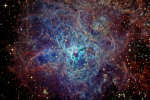 The Cosmic Web of the Tarantula Nebula
11.11.2008
First cataloged as a star, 30 Doradus is actually an immense star forming region in nearby galaxy The Large Magellanic Cloud. The region's spidery appearance is responsible for its popular name, the Tarantula nebula, except that this tarantula is about 1,000 light-years across, and 180,000 light-years away in the southern constellation Dorado.
 APOD: 2025 April 15 Б Planetary Nebula NGC 1514 from Webb
15.04.2025
What happens when a star runs out of nuclear fuel? For stars like our Sun, the center condenses into a white dwarf while the outer atmosphere is expelled into space to appear as a planetary nebula.
 APOD: 2023 October 18 Б Dust and the Western Veil Nebula
18.10.2023
It's so big it is easy to miss. The entire Veil Nebula spans six times the diameter of the full moon, but is so dim you need binoculars to see it. The nebula was created about 15,000 years ago when a star in the constellation of the Swan (Cygnus) exploded.
 The Horsehead Nebula
10.12.2025
Sculpted by stellar winds and radiation, this dusty interstellar molecular cloud has by chance has assumed an immediately recognizable shape. Fittingly known as The Horsehead Nebula, it lies some 1,500 light-years distant, embedded in the vast Orion cloud complex.
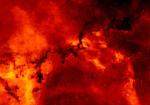 Hydrogen and Dust in the Rosette Nebula
23.12.2005
At the edge of a large molecular cloud in Monoceros, some 3,000 light years away, dark filaments of dust are silhouetted by luminous hydrogen gas. The close up view of the Rosette Nebula...
|
January February March April May June July August |
||||||||||||||||||||||||||||||||||||||||||||||||||||||||