
|
You entered: Earth
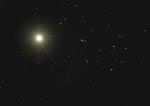 Venus and the Pleiades
15.04.2004
Venus still rules the western skies after sunset as the brilliant evening star. While wandering the ecliptic with its fellow naked-eye planets earlier this month, it passed near the Pleiades star cluster, providing a striking photo opportunity for earthbound skygazers.
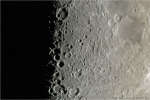 Lunar X
10.03.2009
The striking X near the center of this lunarscape is easily visible in binoculars or a small telescope. Yet, not too many have seen it. The catch is, this lunar X is only apparent during a four hour period just before the Moon's first quarter phase.
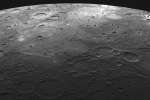 Volcanic Terrain on Mercury
27.05.2009
Why are many large craters on Mercury relatively smooth inside? Recent images from the robotic MESSENGER spacecraft that flew by Mercury last October show previously uncharted regions of Mercury that have large craters with an internal smoothness similar to the maria on Earth's own Moon.
 Planetary Nebula Mz3: The Ant Nebula
25.04.2010
Why isn't this ant a big sphere? Planetary nebula Mz3 is being cast off by a star similar to our Sun that is, surely, round. Why then would the gas that is streaming away create an ant-shaped nebula that is distinctly not round?
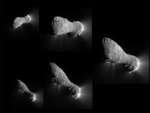 Comet Hartley 2 Flyby
4.11.2010
Follow these 5 frames clockwise starting from the top left to track the view from the EPOXI mission spacecraft as it approached, passed under, and then looked back at the nucleus of comet Hartley 2 on November 4. Its closest approach distance was about 700 kilometers.
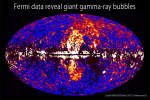 Huge Gamma Ray Bubbles Found Around Milky Way
9.11.2010
Did you know that our Milky Way Galaxy has huge bubbles emitting gamma rays from the direction of the galactic center? Neither did anybody. As the data from the Earth-orbiting Fermi satellite began acuminating over the past two years, however, a large and unusual feature toward our Galaxy's center became increasingly evident.
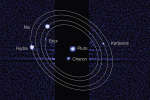 Plutos Newly Discovered Moons Receive Names
8.07.2013
Pluto's newly discovered moons now have names. Known previously as P4 and P5, the International Astronomical Union has now given the fourth and fifth discovered moons of Pluto the names Kerberos and Styx.
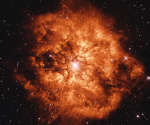 Wolf Rayet Star 124: Stellar Wind Machine
1.07.2014
Some stars explode in slow motion. Rare, massive Wolf-Rayet stars are so tumultuous and hot that they slowly disintegrating right before our telescopes. Glowing gas globs each typically over 30 times more massive than the Earth are being expelled by violent stellar winds.
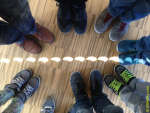 Solar Eclipse Shoes in the Classroom
7.03.2016
The total solar eclipse of March 8/9 will be the only total eclipse in 2016. The New Moon's dark shadow traces a limited, narrow path across planet Earth for viewing the total phase, making landfall in Indonesia and mostly tracking across the Pacific Ocean.
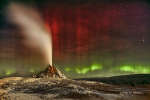 Aurora Over White Dome Geyser
1.10.2016
Sometimes both heaven and Earth erupt. Colorful aurorae erupted unexpectedly a few years ago, with green aurora appearing near the horizon and brilliant bands of red aurora blooming high overhead. A bright Moon lit the foreground of this picturesque scene, while familiar stars could be seen far in the distance.
|
January February March April May June July August September October |
|||||||||||||||||||||||||||||||||||||||||||||||||