
|
You entered: Earth
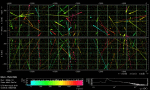 Live: Cosmic Rays from Minnesota
6.08.2018
Cosmic rays from outer space go through your body every second. Typically, they do you no harm. The featured image shows some of these fast moving particles as streaks going through Fermilab's NOvA Far Detector located in Ash River, Minnesota, USA.
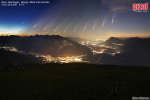 Comet NEOWISE over the Swiss Alps
15.07.2020
Comet NEOWISE has been wowing photographers around much of the world during dawn and dusk, at the margins of day and night. For the most northern residents of planet Earth, however, the comet circles the North Star and never sets.
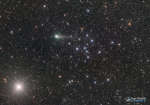 Comet C 2017 K2 (PanSTARRS)
30.06.2022
Imaged on June 20 2022, comet C/2017 K2 (PanSTARRS) shares this wide telescopic field of view with open star cluster IC 4665 and bright star Beta Ophiuchi, near a starry edge of the Milky Way.
 Orion and the Ocean of Storms
7.12.2023
On December 5, 2022, a camera on board the uncrewed Orion spacecraft captured this view as Orion approached its return powered flyby of the Moon. Beyond one of Orion's extended solar arrays lies dark, smooth, terrain along the western edge of the Oceanus Procellarum.
 APOD: 2024 January 28 Б Pluto in True Color
28.01.2024
What color is Pluto, really? It took some effort to figure out. Even given all of the images sent back to Earth when the robotic New Horizons spacecraft sped past Pluto in 2015, processing these multi-spectral frames to approximate what the human eye would see was challenging.
 APOD: 2025 August 25 Б The Meteor and the Star Cluster
25.08.2025
Sometimes even the sky surprises you. To see more stars and faint nebulosity in the Pleiades star cluster (M45), long exposures are made. Many times, less interesting items appear on the exposures that were not intended -- but later edited out.
 APOD: 2025 December 1 Б 3I ATLAS: Tails of an Interstellar Comet
1.12.2025
How typical is our Solar System? Studying 3I/ATLAS, a comet just passing through, is providing clues. Confirmed previous interstellar visitors include an asteroid, a comet, a meteor, and a gas wind dominated by hydrogen and helium.
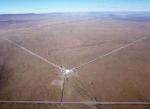 A Step Toward Gravitational Wave Detection
30.10.2000
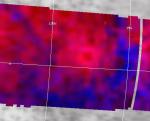
Accelerate a charge and you'll get electromagnetic radiation: light. But accelerate any mass and you'll get gravitational radiation. Light is seen all the time, but, so far, a confirmed direct detection of gravitational radiation has yet to be made.
 Crater On Ice
14.07.2000
Impact craters are common on Earth's moon but on Jupiter's large ice moon Europa, they are very rare. Over time, both bodies have been subjected to an intense pounding by the solar system's formative debris, but geological activity on Europa's surface seems to have erased most of these impact scars.
 Unusual Flashes Toward Globular Cluster M22
3.07.2001
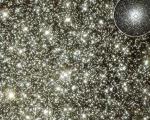
What is causing the unusual flashes behind globular cluster M22? This teaming ball of stars is the brightest globular cluster visible in Earth's northern hemisphere. M22, shown in full in the inset, spans about 50 light years away and lies 8500 light-years toward the constellation of Sagittarius.
|
January February March April May June July August September October |
|||||||||||||||||||||||||||||||||||||||||||||||||