
|
You entered: Earth
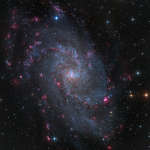 M33: The Triangulum Galaxy
11.11.2021
The small, northern constellation Triangulum harbors this magnificent face-on spiral galaxy, M33. Its popular names include the Pinwheel Galaxy or just the Triangulum Galaxy. M33 is over 50,000 light-years in diameter, third largest in the Local Group of galaxies after the Andromeda Galaxy (M31), and our own Milky Way.
 Trapezium: At the Heart of Orion
4.01.2024
Near the center of this sharp cosmic portrait, at the heart of the Orion Nebula, are four hot, massive stars known as the Trapezium. Gathered within a region about 1.5 light-years in radius, they dominate the core of the dense Orion Nebula Star Cluster.
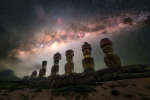 APOD: 2026 March 25 Б The Guardians of Rapa Nui beneath the Milky Way
24.03.2026
In the words of today's astrophotographer, Rositsa Dimitrova, "What have these silent sentinels watched pass across the sky?" The volcanic mo'ai (meaning statue) of Ahu Tongariki stand guard over Rapa Nui (Isla...
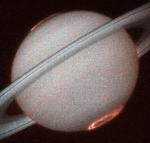 Saturnian Aurora
8.01.1998
Girdling the second largest planet in the Solar System, Saturn's Rings are one of the most spectacular sights for earthbound telescopes. This recently released image, from the orbiting Hubble Space Telescope's STIS instrument, offers a striking view of another kind of ring around Saturn - pole encircling rings of ultraviolet aurora.
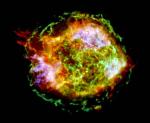 APOD: 2004 August 26- Cassiopeia A in a Million
26.08.2004
One million seconds of x-ray image data were used to construct this view of supernova remnant Cassiopeia A, the expanding debris cloud from a stellar explosion. The stunningly detailed image from the Chandra Observatory will allow an unprecedented exploration of the catastrophic fate that awaits stars much more massive than the Sun.
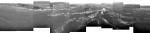 Eight Kilometers Above Titan
18.01.2005
What are these surface features on Titan? Scroll right to see the panoramic view captured last week by the Huygens probe as it descended toward Saturn's mysterious moon. Scientists are not yet sure what the above image is showing.
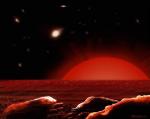 Stars Without Galaxies
26.03.1999
Galaxies are made up of stars, but are all stars found within galaxies? Using the Hubble Space Telescope, researchers exploring the Virgo Cluster of galaxies have now found about 600 red giant stars adrift in intergalactic space. Above is an artist's vision of the sky from a hypothetical planet of such a lonely sun.
 Gordel van Venus
15.06.2006
Scroll right and enjoy this 180 degree panorama across the South African Astronomical Observatory's hilltop Sutherland observing station. Featured are SAAO telescope domes and buildings, along with the dark, wedge-shaped shadow of planet Earth stretching into the distance, bounded above by the delicately colored antitwilight arch.
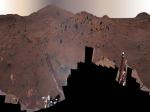 McMurdo Panorama from Mars
31.10.2006
This was Spirit's view on Martian-day 1,000 of its 90-Martian-day mission. The robotic Spirit rover has stayed alive so long on Mars that it needed a place to wait out the cold and dim Martian winter.
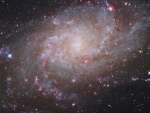 M33: Triangulum Galaxy
13.09.2008
The small, northern constellation Triangulum harbors this magnificent face-on spiral galaxy, M33. Its popular names include the Pinwheel Galaxy or just the Triangulum Galaxy. M33 is over 50,000 light-years in diameter, third largest in the Local Group of galaxies after the Andromeda Galaxy (M31), and our own Milky Way.
|
January February March April May June July August September October |
|||||||||||||||||||||||||||||||||||||||||||||||||