
|
You entered: Earth
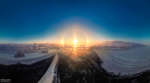 Sun Halo at Sixty three Degrees North
21.12.2022
Happy Solstice! Today is the December solstice, marking an astronomical beginning of summer in the southern hemisphere and winter in the north. On its yearly trek through planet Earth's skies, at this solstice the Sun reaches its southern most declination, 23.5 degrees south, at 21:48 UTC.
 Most of Comet Tsuchinshan ATLAS
18.10.2024
On October 14 it was hard to capture a full view of Comet C/2023 A3 Tsuchinshan-ATLAS. Taken after the comet's closest approach to our fair planet, this evening skyview almost does though. With...
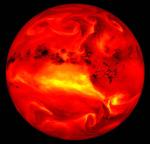 The Water Vapor Channel
23.03.2002
What alien planet's bizarre landscape lurks below these fiery-looking clouds? It's only planet Earth, of course ... as seen on the Water Vapor Channel. Hourly, images like this one (an infrared image shown in false-color) are brought to you by the orbiting Geostationary Operational Environmental Satellites' (GOES) multi-channel imagers.
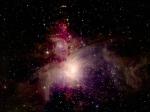 Orion Nebula: The 2MASS View
20.04.2002
Few astronomical sights excite the imagination like the nearby stellar nursery known as the Orion Nebula. The Nebula's glowing gas surrounds hot young stars at the edge of an immense interstellar molecular cloud only 1,500 light-years away.
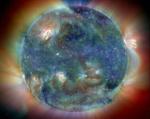 Solstice Celebration
21.12.2002
Aloha and Season's greetings! On December 22nd, at 01:14 Universal Time (December 21, 3:14pm Hawaii-Aleutian Standard Time), the Sun reaches its southernmost point in planet Earth's sky marking the final season change for the year 2002. In celebration, consider this delightfully detailed, brightly colored image of the active Sun.
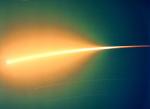 Moon Slide Slim
15.05.2003
No special filters - or even a telescope - are required to enjoy a leisurely lunar eclipse. In fact, watched from all over the night side of planet Earth, these regular celestial performances have entertained many casual skygazers. Still, this eye-catching picture of a lunar eclipse may look unfamiliar.
 Large Sunspot Groups 10484 and 10486
27.10.2003
Two unusually large sunspot groups are now crossing the face of the Sun. Each group, roughly the size of Jupiter, is unusual not only for its size but because it is appearing over three years after solar maximum, the peak of solar surface activity.
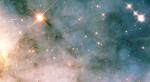 The Turbulent Neighborhood of Eta Carina
26.11.2003
How do violent stars affect their surroundings? To help find out, astronomers pointed the Hubble Space Telescope to the regions surrounding Eta Carina, a star showing signs that it may explode sometime in the next million years.
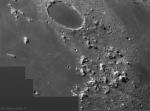 Plato and the Lunar Alps
11.02.2006
The dark-floored, 95 kilometer wide crater Plato (top) and sunlit peaks of the lunar Alps are highlighted in this sharp digital mosaic of the Moon's surface. While the Alps of planet Earth were...
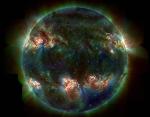 Dark Sun Sizzling
10.07.2006
Is this our Sun? Yes. Even on a normal day, our Sun is sizzling ball of seething hot gas. Unpredictably, regions of strong and tangled magnetic fields arise, causing sunspots and bright active regions. The Sun's surface bubbles as hot hydrogen gas streams along looping magnetic fields.
|
January February March April May June July August September October |
|||||||||||||||||||||||||||||||||||||||||||||||||