
|
You entered: X-ray
 APOD: 2024 March 27 Б The Coma Cluster of Galaxies
27.03.2024
Almost every object in the featured photograph is a galaxy. The Coma Cluster of Galaxies pictured here is one of the densest clusters known - it contains thousands of galaxies. Each of these galaxies houses billions of stars - just as our own Milky Way Galaxy does.
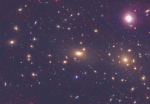 The Coma Cluster of Galaxies
13.12.1997
Almost every object in the above photograph is a galaxy. The Coma Cluster of Galaxies pictured is one of the densest clusters known - it contains thousands of galaxies. Each of these galaxies house billions of stars - just as our own Milky Way Galaxy does.
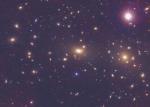 The Coma Cluster of Galaxies
12.10.2003
Almost every object in the above photograph is a galaxy. The Coma Cluster of Galaxies pictured above is one of the densest clusters known - it contains thousands of galaxies. Each of these galaxies houses billions of stars - just as our own Milky Way Galaxy does.
 APOD: 2024 August 28 Б Tulip Nebula and Black Hole Cygnus X 1
28.08.2024
When can you see a black hole, a tulip, and a swan all at once? At night -- if the timing is right, and if your telescope is pointed in the right direction. The complex and beautiful Tulip Nebula blossoms about 8,000 light-years away toward the constellation of Cygnus the Swan.
 APOD: 2024 September 18 Б The Mermaid Nebula Supernova Remnant
18.09.2024
New stars are born from the remnants of dead stars. The gaseous remnant of the gravitational collapse and subsequent death of a very massive star in our Milky Way created the G296.5+10.0 supernova remnant, of which the featured Mermaid Nebula is part.
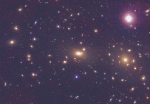 The Coma Cluster of Galaxies
5.11.1996
Almost every object in the above photograph is a galaxy. The Coma Cluster of Galaxies pictured is one of the densest clusters known - it contains thousands of galaxies. Each of these galaxies house billions of stars - just like our own Milky Way Galaxy.
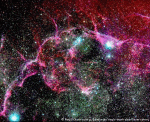 Vela Supernova Remnant in Optical
13.07.1997
About 11,000 years ago a star in the constellation of Vela exploded. This bright supernova may have been visible to the first human farmers. Today the Vela supernova remnant marks the position of a relatively close and recent explosion in our Galaxy. A roughly spherical, expanding shock wave is visible in X-rays.
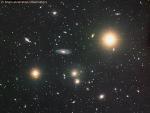 The Hydra Cluster of Galaxies
16.04.2001
The Hydra Cluster of Galaxies contains well over 100 bright galaxies - but perhaps fewer galaxies than might be expected from its mass. Clusters of galaxies are the largest gravitationally bound objects in the universe.
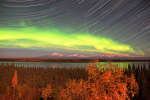 Aurora Over Alaska
6.10.2010
Are those green clouds or aurora? Photographed above two weeks ago, puffy green aurora help the Moon illuminate the serene Willow Lake and the snowy Wrangell and Saint Elias Mountains in eastern Alaska, USA.
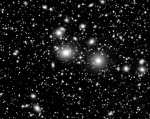 The Perseus Cluster of Galaxies
15.08.1998
Here is one of the largest objects that anyone will ever see on the sky. Each of the fuzzy blobs in the above picture is a galaxy, together making up the Perseus Cluster, one of the closest clusters of galaxies.
|
January February March April May June July August September October |
|||||||||||||||||||||||||||||||||||||||||||||||||