
|
You entered: X-ray
 A Delta Rocket Launches
13.12.1995
A Delta rocket is seen being launched in 1988. In use since 1960, Delta rockets have been launched successfully over 200 times. Scientific satellites placed into orbit by a Delta rocket include IUE, COBE, LAGEOS-I, ROSAT, EUVE, GEOTAIL, and WIND.
 A Lonely Neutron Star
26.09.1997
How massive can a star get without imploding into a black hole? These limits are being tested by the discovery of a lone neutron star in space. Observations by the Hubble Space Telescope released...
 The Perseus Cluster of Galaxies
25.10.2004
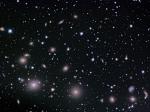
Here is one of the largest objects that anyone will ever see on the sky. Each of the fuzzy blobs in the above picture is a galaxy, together making up the Perseus Cluster, one of the closest clusters of galaxies.
 Spiral Galaxy NGC 2841
29.03.2008
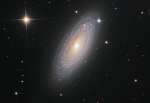
Some 50 million light-years distant, spiral galaxy NGC 2841 can be found in the northern constellation of Ursa Major. This sharp view of the gorgeous island universe shows off a striking yellow nucleus and galactic disk with tightly wound spiral arms.
 The Galactic Center Radio Arc
3.04.2005
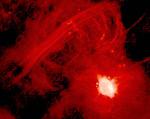
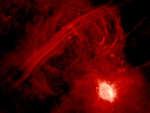
What causes this unusual structure near the center of our Galaxy? The long parallel rays slanting across the top of the above radio image are known collectively as the Galactic Center Radio Arc and jut straight out from the Galactic plane.
 The Galactic Center Radio Arc
27.04.2008
What causes this unusual structure near the center of our Galaxy? The long parallel rays slanting across the top of the above radio image are known collectively as the Galactic Center Radio Arc and jut straight out from the Galactic plane.
 The Antikythera Mechanism
9.01.2011
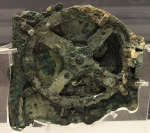
What is it? It was found at the bottom of the sea aboard an ancient Greek ship. Its seeming complexity has prompted decades of study, although some of its functions remained unknown. Recent X-rays of the device have now confirmed the nature of the Antikythera mechanism, and discovered several surprising functions.
 NGC 6814: Grand Design Spiral Galaxy from Hubble
21.06.2016
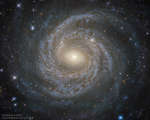
In the center of this serene stellar swirl is likely a harrowing black-hole beast. The surrounding swirl sweeps around billions of stars which are highlighted by the brightest and bluest. The breadth and beauty of the display give the swirl the designation of a grand design spiral galaxy.
 The Antikythera Mechanism
20.01.2013
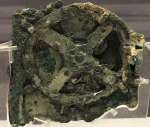
What is it? It was found at the bottom of the sea aboard an ancient Greek ship. Its seeming complexity has prompted decades of study, although some of its functions remained unknown. X-ray images of the device have confirmed the nature of the Antikythera mechanism, and discovered several surprising functions.
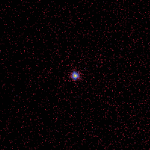 Sirius: The Brightest Star in the Night
2.09.1996
Sirius is the brightest star in the night sky. Intrinsically, Sirius is over 20 times brighter than our Sun and over twice as massive. As Sirius is 8.7 light years distant, it is not the closest star system -- the Alpha Centauri system holds this distinction.
|
January February March April May June July August September October |
|||||||||||||||||||||||||||||||||||||||||||||||||