
|
You entered: X-ray
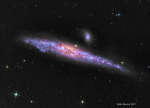 NGC 4631: The Whale Galaxy
6.10.2022
NGC 4631 is a big beautiful spiral galaxy. Seen edge-on, it lies only 25 million light-years away in the well-trained northern constellation Canes Venatici. The galaxy's slightly distorted wedge shape suggests to some a cosmic herring and to others its popular moniker, The Whale Galaxy.
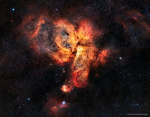 The Great Nebula in Carina
13.06.2017
In one of the brightest parts of Milky Way lies a nebula where some of the oddest things occur. NGC 3372, known as the Great Nebula in Carina, is home to massive stars and changing nebulas.
 A Powerful Solar Flare
29.10.2003
Yesterday, our Sun produced one of the most powerful solar flares in recorded history. Seen across the electromagnetic spectrum, the Sun briefly became over 100 times brighter in X-rays than normal. Over the next few days, as energetic particles emitted from these regions strike the Earth, satellite communications might be affected and auroras might develop.
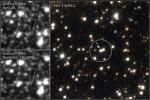 A Big Black Hole Floats By
19.01.2000
A black hole glides silently through space. Is there any way to know it's there? Until last week, all objects that might be black holes in our Galaxy were part of binary star systems.
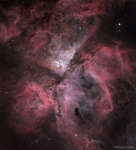 The Great Nebula in Carina
23.03.2016
In one of the brightest parts of Milky Way lies a nebula where some of the oddest things occur. NGC 3372, known as the Great Nebula in Carina, is home to massive stars and changing nebulas.
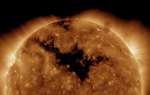 Hole in the Sun
28.08.2010
This ominous, dark shape sprawling across the face of the Sun is a coronal hole -- a low density region extending above the surface where the solar magnetic field opens freely into interplanetary space. Studied...
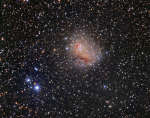 Starburst Galaxy IC 10
4.01.2012
Lurking behind dust and stars near the plane of our Milky Way Galaxy, IC 10 is a mere 2.3 million light-years distant. Even though its light is dimmed by intervening dust, the irregular dwarf galaxy still shows off vigorous star-forming regions that shine with a telltale reddish glow in this colorful skyscape.
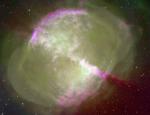 M27: The Dumbbell Nebula
6.03.2001
The first hint of what will become of our Sun was discovered inadvertently in 1764. At that time, Charles Messier was compiling a list of "annoying" diffuse objects not to be confused with "interesting" comets.
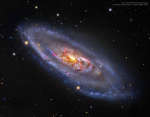 M106: A Spiral Galaxy with a Strange Center
17.03.2019
What's happening at the center of spiral galaxy M106? A swirling disk of stars and gas, M106's appearance is dominated by blue spiral arms and red dust lanes near the nucleus, as shown in the featured image.
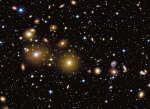 The Perseus Cluster of Galaxies
20.05.2008
Here is one of the largest objects that anyone will ever see on the sky. Each of these fuzzy blobs is a galaxy, together making up the Perseus Cluster, one of the closest clusters of galaxies. The cluster is seen through a foreground of faint stars in our own Milky Way Galaxy.
|
January February March April May June July August September October |
|||||||||||||||||||||||||||||||||||||||||||||||||