
|
You entered: X-ray
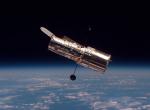 Hubble Floats Free
24.11.2002
Why put observatories in space? Most telescopes are on the ground. On the ground, you can deploy a heavier telescope and fix it more easily. The trouble is that Earth-bound telescopes must look through the Earth's atmosphere.
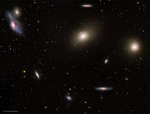 In the Heart of the Virgo Cluster
7.04.2015
The Virgo Cluster of Galaxies is the closest cluster of galaxies to our Milky Way Galaxy. The Virgo Cluster is so close that it spans more than 5 degrees on the sky - about 10 times the angle made by a full Moon.
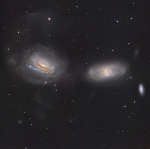 APOD: 2026 May 18 Б Unraveling NGC 3169
18.05.2026
Spiral galaxy NGC 3169 looks to be unraveling like a ball of cosmic yarn. It lies some 70 million light-years away, south of bright star Regulus toward the faint constellation Sextans. Wound up spiral arms are pulled out into sweeping tidal tails as NGC 3169 (left) and neighboring NGC 3166 interact gravitationally.
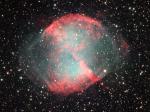 M27: The Dumbbell Nebula
3.06.2005
The first hint of what will become of our Sun was discovered inadvertently in 1764. At that time, Charles Messier was compiling a list of diffuse objects not to be confused with comets.
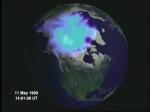 Unusual Aurora During Solar Wind Dropout
23.12.1999
On May 10, for some unknown reason, the Solar Wind virtually stopped. Normally our Sun emits a wind of between five and ten energetic particles per cubic centimeter moving outward at about 500 kilometers per second.
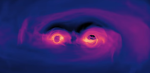 Spiraling Supermassive Black Holes
3.12.2018
Do black holes glow when they collide? When merging, co-orbiting black holes are sure to emit a burst of unusual gravitational radiation, but will they emit light, well before that, if they are surrounded by gas? To help find out, astrophysicists created a sophisticated computer simulation.
 APOD: 2023 May 3 Б Centaurus A: A Peculiar Island of Stars
3.05.2023
Galaxies are fascinating. In galaxies, gravity alone holds together massive collections of stars, dust, interstellar gas, stellar remnants and dark matter. Pictured is NGC 5128, better known as Centaurus A. Cen A is the fifth brightest galaxy on the sky and is located at a distance of about 12 million light years from Earth.
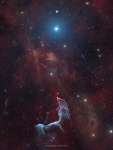 APOD: 2026 June 11 Б The Mermaid Nebula Supernova Remnant
11.06.2026
Could the Little Mermaid turn into stardust instead of seafoam? It would seem so in this beautiful nebula. The featured image shows the Mermaid Nebula, also known as the Betta Fish Nebula, which is part of the G296.5+10.0 Supernova Remnant.
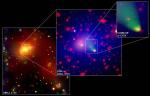 C153 Takes the Plunge
6.09.2004
A comet-like tail of glowing gas, 200,000 light-years long, streams from galaxy C153 as it plunges through galaxy cluster Abell 2125 at nearly 8 million kilometers per hour. Itself a member of the giant cluster of galaxies, C153 may once have been a spiral galaxy like the Milky Way.
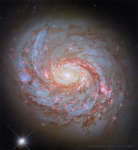 APOD: 2025 December 2 Б M77: Spiral Galaxy with an Active Center
2.12.2025
What's happening in the center of nearby spiral galaxy M77? The face-on galaxy lies a mere 47 million light-years away toward the constellation of the Sea Monster (Cetus). At that estimated distance, this gorgeous island universe is about 100 thousand light-years across.
|
January February March April May June July August September October |
|||||||||||||||||||||||||||||||||||||||||||||||||