
|
You entered: unusual
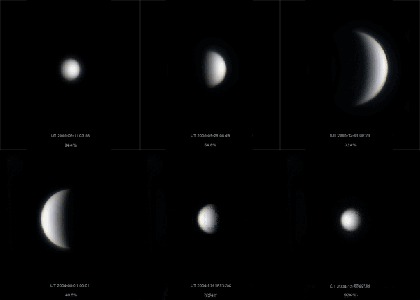 The Phases of Venus
10.01.2006
Venus goes through phases. Just like our Moon, Venus can appear as full as a disk or as a thin as a crescent. Venus, frequently the brightest object in the post-sunset or pre-sunrise sky, appears so small, however, that it usually requires binoculars or a small telescope to clearly see its current phase.
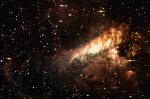 M17: The Omega Nebula
26.01.1999
The Omega Nebula contains glowing gas, dark dust, and some unusually massive stars. Also known as the M17 and the Swan Nebula, the Omega Nebula is about 5000 light-years away, 20 light-years across, and visible with binoculars in the constellation of Sagittarius.
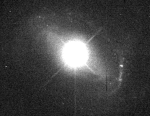 Why is QSO 1229+204 so Bright?
24.08.1996
What causes the center of this barred spiral galaxy to light up brighter than almost anything in the universe? The quasar there is a good fraction of the way across our observable universe...
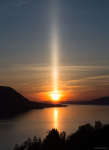 A Sun Pillar over Norway
6.06.2018
Have you ever seen a sun pillar? When the air is cold and the Sun is rising or setting, falling ice crystals can reflect sunlight and create an unusual column of light. Ice sometimes forms flat, six-sided shaped crystals as it falls from high-level clouds.
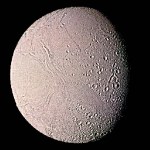 Saturn's Cleanest Moon: Enceladus
25.11.1995
Enceladus orbits Saturn between the smaller Mimas and the larger Tethys. Enceladus is composed mostly of water ice and has the cleanest and purest ice surface in the Solar System. It's surface therefore appears nearly white. The surface also has many unusual groves and relatively few craters, like Jupiter's moon Ganymede.
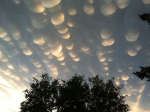 Mammatus Clouds Over Saskatchewan
23.10.2012
Normal cloud bottoms are flat. This is because moist warm air that rises and cools will condense into water droplets at a specific temperature, which usually corresponds to a very specific height. As water droplets grow, an opaque cloud forms.
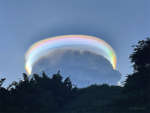 An Iridescent Pileus Cloud over China
6.09.2022
Yes, but how many dark clouds have a multicolored lining? Pictured, behind this darker cloud, is a pileus iridescent cloud, a group of water droplets that have a uniformly similar size and so together diffract different colors of sunlight by different amounts. The featured image was taken last month in Pu'er, Yunnan Province, China.
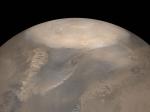 Spring Dust Storms at the North Pole of Mars
24.12.2002
Spring reached the north pole of Mars in May, and brought with it the usual dust storms. As the north polar cap begins to thaw, a temperature difference occurs between the cold frost region and recently thawed surface, resulting in swirling winds between the adjacent regions.
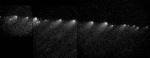 A String Of Pearls
13.07.1995
Comet Shoemaker-Levy 9, named after its co-discoverers, was often referred to as the "string of pearls" comet. It is famous for its unusual appearance as well as its collision with the planet Jupiter!
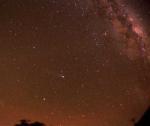 Comet Hyakutake and the Milky Way
17.08.1998
Two years ago, the Great Comet of 1996, Comet Hyakutake, inched across our northern sky during its long orbit around the Sun. Visible above as the bright spot with the faint tail near...
|
January February March April May June July August |
||||||||||||||||||||||||||||||||||||||||||||||||||||||||