
|
You entered: unusual
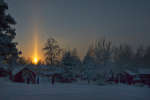 A Sun Pillar Over Sweden
18.12.2012
Have you ever seen a sun pillar? When the air is cold and the Sun is rising or setting, falling ice crystals can reflect sunlight and create an unusual column of light. Ice sometimes forms flat, six-sided shaped crystals as it falls from high-level clouds.
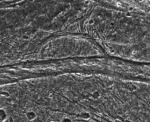 Mysterious Features on Ganymede
9.12.1997
Where is the rest of the circle? Jupiter's largest moon Ganymede has some truly unusual terrain, including the pictured half circle above cut by nearly parallel curves. Full circles can be easily explained by impact craters, but partial circles imply that some resurfacing has occurred since the original impact.
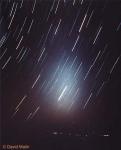 Zodiacal Light
13.06.1999
Sometimes the sky itself seems to glow. Usually, this means you are seeing a cloud reflecting sunlight or moonlight. If the glow appears as a faint band of light running across the whole sky, you are probably seeing the combined light from the billions of stars that compose our Milky Way Galaxy.
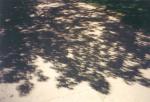 The Eclipse Tree
25.12.2000
If you look closely at the shadow of this tree, you will see something quite unusual: it is composed of hundreds of images of a partially eclipsed Sun. Early today, trees across North America will be casting similar shadows as a partial eclipse of the Sun takes place.
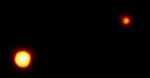 Pluto: The Frozen Planet
28.12.1997
The Hubble Space Telescope imaged Pluto and its moon Charon in 1994. Pluto is usually the most distant planet from the Sun but because of its elliptic orbit Pluto crossed inside of Neptune's orbit in 1979 and will cross back out again in 1999.
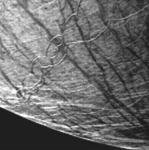 Ice Cusps on Europa
9.06.1998
Europa's icy crust has many unusual features. Pictured above is part of Europa's southern hemisphere photographed by the Galileo spacecraft currently orbiting Jupiter. Europa is one of the largest moons of Jupiter, and is thought to have oceans of water underneath its ice-covered surface.
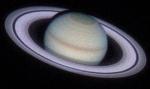 Saturn in Color
12.03.1997
Saturn is unusual but photogenic. The second largest planet in our Solar System, behind Jupiter, has been easily identifiable at night since history has been recorded. It was only with the invention of the telescope, however, that any evidence of its majestic ring system became apparent.
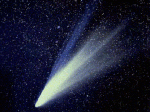 Two Tails of Comet West
26.08.1995
Here Comet West is seen showing two enormous tails that wrap around the sky. The ion tale of a comet usually appears more blue and always points away from the Sun. The dust tail trailing the comet's nucleus is the most prominent.
 A Jupiter Venus Conjunction
8.03.1999
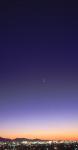
Venus and Jupiter appeared unusually close together in the sky last month. The conjunction was easily visible to the unaided eye because Venus appears brighter than any background star. The two planets were not significantly closer in space - Venus just passed nearly in front of Jupiter as seen from the Earth.
 A Sun Pillar
6.07.1999
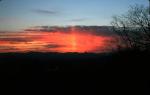
Have you ever seen a sun pillar? When the air is cold and the Sun is rising or setting, falling ice crystals can reflect sunlight and create an unusual column of light. Ice sometimes forms flat, stop-sign shaped crystals as it falls from high-level clouds.
|
January February March April May June July August |
||||||||||||||||||||||||||||||||||||||||||||||||||||||||