
|
You entered: star
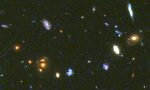 Distant Galaxies
7.09.1995
This Hubble Space Telescope image of a group of faint galaxies "far, far away" is a snap shot of the Universe when it was young. The bluish, irregularly shaped galaxies revealed in the image are up to eight billion light years away and seem to have commonly undergone galaxy collisions and bursts of star formation.
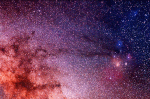 The Pipe Dark Nebula
28.05.1996
The dark nebula predominant at the lower left of the above photograph is known as the Pipe Nebula. The dark clouds, suggestively shaped like smoke rising from a pipe, are caused by absorption of background starlight by dust.
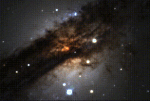 Dusty Galaxy Centaurus A
30.03.1997
One of the most unusual galaxies known, Centaurus A, is pictured above. Cen A is marked by dramatic dust lanes that run across the galaxy's center. These dust lanes are so thick they almost completely obscure the galaxy's center in visible light.
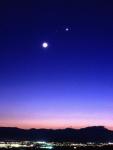 Moon Over California
18.04.1999
The Moon, Saturn, and Venus shine above while city lights twinkle below in the deepening twilight of March 19. Taken from outside Indio, California, the photo shows the city lights of Indio and nearby Palm Springs.
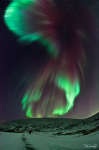 A Memorable Aurora Over Norway
5.12.2011
It was one of the most memorable auroras of the season. There was green light, red light, and sometimes a mixture of the two. There were multiple rays, distinct curtains, and even an auroral corona. It took up so much of the sky.
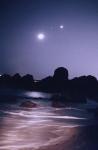 A Laguna Triangle
18.05.1999
High above Laguna Beach last month hung bright celestial orbs. Visible after the California sunset were, from left to right, the Moon, Saturn, and Venus. Tonight and for the next few days, Venus and the Moon will again be visible together. Nearby stars will include Pollux, Castor, and Procyon.
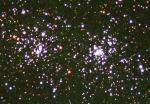 NGC 869 & NGC 884: A Double Open Cluster
29.01.1997
Most star clusters are singularly impressive. But open clusters NGC 869 and NGC 884 are doubly impressive. Also known as "h and chi Persei", this rare double cluster, shown above, is bright enough to be seen from a dark location without even binoculars.
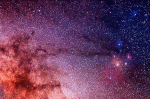 The Pipe Dark Nebula
21.06.1997
The dark nebula predominant at the lower left of the above photograph is known as the Pipe Nebula. The dark clouds, suggestively shaped like smoke rising from a pipe, are caused by absorption of background starlight by dust.
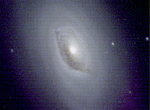 M64: The Sleeping Beauty Galaxy
11.07.1998
The Sleeping Beauty galaxy may appear peaceful at first sight but it is actually tossing and turning. In an unexpected twist, recent observations have shown that the center of this photogenic galaxy is rotating in the opposite direction than the outer regions!
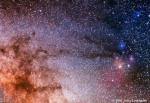 The Pipe Dark Nebula
5.03.2000
The dark nebula predominant at the lower left of the above photograph is known as the Pipe Nebula. The dark clouds, suggestively shaped like smoke rising from a pipe, are caused by absorption of background starlight by dust.
|
January February March April May June July August September October |
|||||||||||||||||||||||||||||||||||||||||||||||||