
|
You entered: star
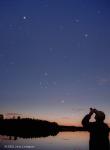 Dusk of the Planets
29.04.2002
A great grouping of planets is now visible to the west just after sunset. Over the next two weeks, Mercury, Venus, Earth, Mars, Jupiter, and Saturn -- all the planets of the inner Solar System -- can be seen in a single knowing glance. The image on the left captured them all in one frame.
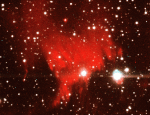 Nebula Nova Cygni Turns On
16.12.1996
Old photographs show no evidence of the above nebula. In 1992, a white dwarf star in Cygnus blew off its outer layers in a classical nova explosion: an event called Nova Cygni 1992. Light flooded the local interstellar neighborhood, illuminated this existing gas cloud, excited the existing hydrogen, and hence caused the red emission.
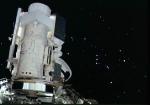 Astro 1 In Orbit
17.08.1997
In December of 1990, the Space Shuttle Columbia carried an array of astronomical telescopes high above the Earth's obscuring atmosphere to observe the Universe at ultraviolet and x-ray wavelengths. The telescopes, known...
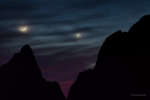 Twilight in a Western Sky
31.03.2018
A slender crescent Moon and inner planets Venus and Mercury never wander far from the Sun in planet Earth's skies. In the fading evening twilight of March 18, they line up near the western horizon in this atmospheric skyscape.
 Hale-Bopp and Orion
29.04.1997
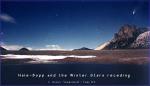
Comet Hale-Bopp is still brighter than most constellations. In fact, Comet Hale-Bopp may now hold the record for staying bright the longest. Last week the comet was photographed above in the same field...
 The Annotated Galactic Center
11.11.1997
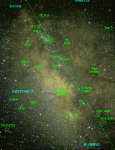
The sky toward the center of our Galaxy is filled with a wide variety of celestial wonders. Most are visible with only binoculars. Constellations of nearby stars include Sagittarius, Libra, Scorpius, Scutum, and Ophiuchus. Nebulae include Messier Objects M8, M16, M17, M20 and the Pipe Nebula.
 M61: Virgo Spiral Galaxy
22.09.1998
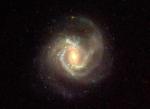
M61 is a barred spiral galaxy located in the nearby Virgo Cluster of Galaxies. Visible in M61 are a host of features common to spiral galaxies: bright spiral arms, a central bar, dust lanes, and bright knots of stars. M61, also known as NGC 4303, in similar to our own Milky Way Galaxy.
 ESO202-G23: Merging Galaxies
1.01.1999
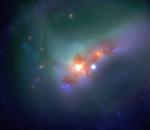
ESO202-G
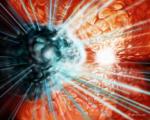 Lasers in Eta Carinae
29.11.1997
Have you heard about the great LASER light show in the sky? A team led by K. Davidson (U. Michigan) and S. Johansson (U. Lund) discovered that the chaotically variable star Eta Carinae emits ultraviolet light in such a narrow band that it is most probably LASER light!
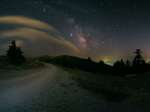 Milky Way Road Trip
5.09.2008
In search of planets and the summer Milky Way, astronomer Tunç Tezel took an evening road trip. Last Saturday, after driving the winding road up Uludag, a mountain near Bursa, Turkey, he was rewarded by this beautiful skyview to the south.
|
January February March April May June July August September October |
|||||||||||||||||||||||||||||||||||||||||||||||||