
|
You entered: Earth
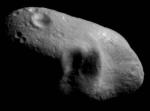 NEAR Shoemaker Views Eros
11.02.2001
Orbiting asteroid 433 Eros, 145 million miles from Earth, NASA's NEAR spacecraft has been returning stunning views as its year long mission of exploration nears completion. A mosaic of NEAR images recorded at a range of about 127 miles, this picture illustrates some of the amazing
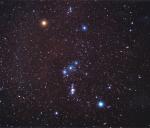 Orion on Film
7.02.2003
Orion, the Hunter, is one of the most easily recognizable constellations in planet Earth's night sky. But Orion's stars and nebulae don't look quite as colorful to the eye as they do in this lovely photograph, taken last month from Vekol Ranch south of Phoenix, Arizona, USA.
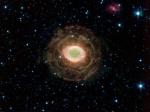 Infrared Ring Nebula
11.03.2005
The classic appearance of the popular Ring Nebula (aka M57) is understood to be due to perspective - our view from planet Earth looks down the center of a roughly barrel-shaped cloud of gas.
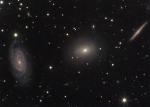 Three Galaxies in Draco
6.05.2006
This intriguing trio of galaxies is sometimes called the NGC 5985/Draco Group and so (quite reasonably) is located in the northern constellation Draco. From left to right are face-on spiral NGC 5985, elliptical galaxy...
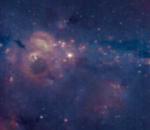 Journey to the Center of the Galaxy
22.04.2000
In Jules Verne's science fiction classic A Journey to the Center of the Earth, Professor Hardwigg and his fellow explorers encounter many strange and exciting wonders. What wonders lie at the center of our Galaxy?
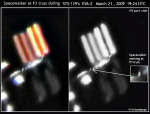 ISS and Astronaut
10.04.2009
These two frames, taken with a video camera and a telescope, reveal remarkable details of the International Space Station (ISS) orbiting some 350 kilometers above planet Earth. Recorded during last month's visit...
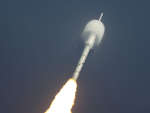 Ares 1 X Rocket Lifts Off
2.11.2009
Last week, NASA test fired a new rocket. The Ares 1-X was the first non-shuttle rocket launched from Kennedy Space Center since the Saturn launched humans to Earth orbit and the Moon in the 1960s and 1970s. NASA is testing Ares as a prelude to replacing the aging space shuttle fleet.
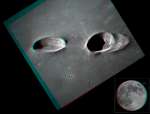 Messier Craters in Stereo
11.12.2009
Many bright nebulae and star clusters in planet Earth's sky are associated with the name of astronomer Charles Messier, from his famous 18th century catalog. His name is also given to these two large and remarkable craters on the Moon.
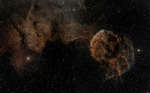 Sharpless 249 and the Jellyfish Nebula
2.12.2014
Normally faint and elusive, the Jellyfish Nebula is caught in this alluring telescopic mosaic. The scene is anchored right and left by two bright stars, Mu and Eta Geminorum, at the foot of the celestial twin while the Jellyfish Nebula is the brighter arcing ridge of emission with dangling tentacles below and right of center.
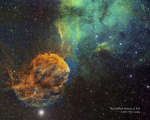 Sharpless 249 and the Jellyfish Nebula
7.01.2017
Normally faint and elusive, the Jellyfish Nebula is caught in this alluring telescopic mosaic. The scene is anchored below by bright star Eta Geminorum, at the foot of the celestial twin, while the Jellyfish Nebula is the brighter arcing ridge of emission with tentacles dangling below and left of center.
|
January February March April May June July August September October |
|||||||||||||||||||||||||||||||||||||||||||||||||