
|
You entered: Earth
 GLOBE at Night: Help Track Light Pollution
18.03.2009
How many stars can you see? Through next week, the GLOBE at Night project invites people from all over the world to go outside at night, look up, and see! Specifically, people are invited to go out an hour after sunset and look for the constellation Orion toward the west.
 A Spring Sky Over Hirsau Abbey
6.05.2009
What's in the sky tonight? When strolling outside just after sunset, even if just going out to your car, a casual glance upwards can reveal a beautiful night sky also seen by many people across the Earth.
 The Seagull and The Duck
19.03.2010
Seen as a seagull and a duck, these nebulae are not the only cosmic clouds to evoke images of flight. But both are winging their way across this broad celestial landscape, spanning almost 7 degrees across planet Earth's night sky toward the constellation Canis Major.
 Geminid Meteors over Chile
23.12.2013
From a radiant point in the constellation of the Twins, the annual Geminid meteor shower rained down on planet Earth over the past few weeks. Recorded near the shower's peak over the night...
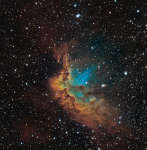 The Wizard Nebula
29.08.2014
Open star cluster NGC 7380 is still embedded in its natal cloud of interstellar gas and dust popularly known as the Wizard Nebula. Seen with foreground and background stars along the plane of our Milky Way galaxy it lies some 8,000 light-years distant, toward the constellation Cepheus.
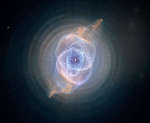 The Cat's Eye Nebula from Hubble
8.11.2014
To some, it may look like a cat's eye. The alluring Cat's Eye nebula, however, lies three thousand light-years from Earth across interstellar space. A classic planetary nebula, the Cat's Eye (NGC 6543) represents a final, brief yet glorious phase in the life of a sun-like star.
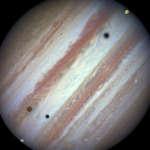 Jupiter Triple Moon Conjunction
5.02.2015
Our solar system's ruling giant planet Jupiter and 3 of its 4 large Galilean moons are captured in this single Hubble snapshot from January 24. Crossing in front of Jupiter's banded cloud tops Europa, Callisto, and Io are framed from lower left to upper right in a rare triple-moon conjunction.
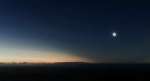 Time Lapse: A Total Solar Eclipse
20.08.2017
Have you ever experienced a total eclipse of the Sun? This time-lapse movie depicts such an eclipse in dramatic detail, seen from Australia in 2012. As the video begins, a slight dimming of the Sun and the surrounding Earth is barely perceptible.
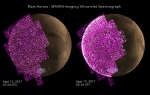 Global Aurora at Mars
6.10.2017
A strong solar event last month triggered intense global aurora at Mars. Before (left) and during (right) the solar storm, these projections show the sudden increase in ultraviolet emission from martian aurora, more than 25 times brighter than auroral emission previously detected by the orbiting MAVEN spacecraft.
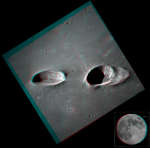 Messier Craters in Stereo
2.12.2017
Many bright nebulae and star clusters in planet Earth's sky are associated with the name of astronomer Charles Messier, from his famous 18th century catalog. His name is also given to these two large and remarkable craters on the Moon.
|
January February March April May June July August September October |
|||||||||||||||||||||||||||||||||||||||||||||||||