
|
You entered: Earth
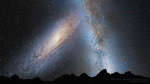 Milky Way Galaxy Doomed: Collision with Andromeda Pending
5.06.2022
Will our Milky Way Galaxy collide one day with its larger neighbor, the Andromeda Galaxy? Most likely, yes. Careful plotting of slight displacements of M31's stars relative to background galaxies on recent Hubble...
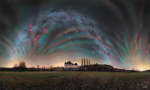 APOD: 2023 February 15 Б Airglow Sky over France
14.02.2023
This unusual sky was both familiar and unfamiliar. The photographer's mission was to capture the arch of the familiar central band of our Milky Way Galaxy over a picturesque medieval manor. The surprise was that on this January evening, the foreground sky was found glowing in a beautiful but unfamiliar manner.
 APOD: 2025 August 13 Б Trapezium: In the Heart of Orion
12.08.2025
What lies in the heart of Orion? Trapezium: four bright stars, that can be found near the center of this sharp cosmic portrait. Gathered within a region about 1.5 light-years in radius, these stars dominate the core of the dense Orion Nebula Star Cluster.
 Galaxies in the Furnace
3.12.2025
An example of violence on a cosmic scale, enormous elliptical galaxy NGC 1316 lies about 75 million light-years away toward Fornax, the southern constellation of the Furnace. Investigating the startling sight, astronomers suspect...
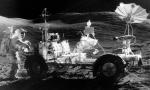 Apollo 17 s Lunar Rover
9.06.2001
In December of 1972, Apollo 17 astronauts Eugene Cernan and Harrison Schmitt spent about 75 hours exploring the Moon's Taurus-Littrow valley while colleague Ronald Evans orbited overhead. Cernan and Schmitt were the last humans to walk or ride on the Moon - aided in their explorations by a Lunar Roving Vehicle.
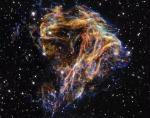 N49 s Cosmic Blast
4.07.2003
Scattered debris from a cosmic supernova explosion lights up the sky in this gorgeous composited image based on data from the Hubble Space Telescope. Cataloged as N49, these glowing filaments of shocked gas span about 30 light-years in our neighboring galaxy, the Large Magellanic Cloud.
 Structure in N63A
31.12.2003
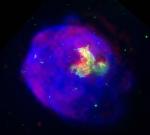
Shells and arcs abound in this false-color, multiwavelength view of supernova remnant N63A, the debris of a massive stellar explosion. The x-ray emission (blue), is from gas heated to 10 million degrees C as knots of fast moving material from the cosmic blast sweep up surrounding interstellar matter.
 Solar System Portrait
13.02.2004
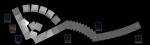
On another Valentine's Day (February 14, 1990), cruising four billion miles from the Sun, the Voyager 1 spacecraft looked back to make this first ever family portrait of our Solar System. The complete portrait is a 60 frame mosaic made from a vantage point 32 degrees above the ecliptic plane.
 A Radar View of Titan
23.11.2004
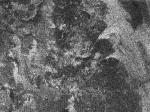
Where are Titan's craters? Throughout our Solar System's five billion-year history, dangerous rocks and chunks of ice have continually slammed into planets and moons - usually creating numerous long lasting impact craters. When the robot spacecraft Cassini swooped past Saturn's moon Titan last month, however, radar images showed few craters.
 SNR 0103 72.6: Oxygen Supply
13.08.2005
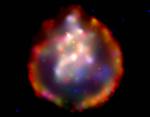
A supernova explosion, a massive star's inevitable and spectacular demise, blasts back into space debris enriched in the heavy elements forged in its stellar core. Incorporated into future stars and planets, these are the elements ultimately necessary for life. Seen here in a false-color x-ray image, supernova remnant SNR 0103-72
|
January February March April May June July August September October |
|||||||||||||||||||||||||||||||||||||||||||||||||