
|
You entered: NASA
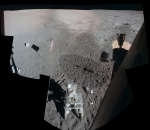 Apollo 14: A View from Antares
4.02.2021
Fifty years ago this Friday, Apollo 14's Lunar Module Antares landed on the Moon. Toward the end of the stay astronaut Ed Mitchell snapped a series of photos of the lunar surface while looking out a window, assembled into this detailed mosaic by Apollo Lunar Surface Journal editor Eric Jones.
 APOD: 2023 November 8 Б Perseus Galaxy Cluster from Euclid
8.11.2023
There's a new space telescope in the sky: Euclid. Equipped with two large panoramic cameras, Euclid captures light from the visible to the near-infrared. It took five hours of observing for Euclid...
 APOD: 2024 July 30 Б Arp 142: Interacting Galaxies from Webb
30.07.2024
To some, it looks like a penguin. But to people who study the universe, it is an interesting example of two big galaxies interacting. Just a few hundred million years ago, the upper NGC 2936 was likely a normal spiral galaxy: spinning, creating stars, and minding its own business.
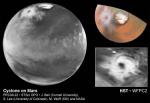 Cyclone on Mars
20.05.1999
Late last month a team of Mars-watching astronomers sighted an immense cyclonic storm system raging near the Red Planet's north pole. Their discovery picture, made with the Hubble Space Telescope on April 27, is seen at left while the projected insets (right) show closeups of the storm and surrounding areas.
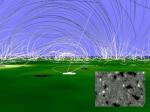 The Magnetic Carpet Of The Sun
24.10.1999
The Sun has a magnetic carpet. Its visible surface appears to be carpeted with tens of thousands of magnetic north and south poles joined by looping field lines which extend outward into the Solar Corona.
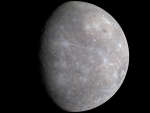 Mercury in Accentuated Color
19.03.2008
The colors of Mercury are subtle but beautiful. At first glance, our Solar System's innermost planet appears simply black and white, but images that include infrared colors normally beyond human vision accentuate a world of detail. One such image, shown above, was acquired by the robotic MESSENGER spacecraft that swung by Mercury in mid-January.
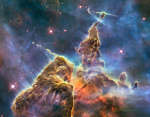 Dust Pillar of the Carina Nebula
26.04.2010
Inside the head of this interstellar monster is a star that is slowly destroying it. The monster, on the right, is actually an inanimate pillar of gas and dust that measures over a light year in length.
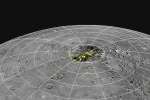 Northern Mercury
1.12.2012
Innermost planet Mercury would probably not be a good location for an interplanetary winter olympics. But new results based on data from the Mercury orbiting MESSENGER spacecraft indicate that it does have substantial water ice in permanently shadowed regions within craters near its north pole.
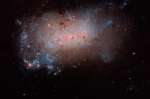 NGC 4449: Close up of a Small Galaxy
14.07.2017
(xxxedit and linkxxx) Grand spiral galaxies often seem to get all the glory. Their young, blue star clusters and pink star forming regions along sweeping spiral arms are guaranteed to attract attention. But small irregular galaxies form stars too, like NGC 4449, about 12 million light-years distant.
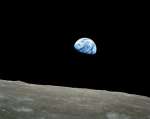 Earthrise: A Video Reconstruction
23.12.2018
About 12 seconds into this video, something unusual happens. The Earth begins to rise. Never seen by humans before, the rise of the Earth over the limb of the Moon occurred 50 years ago tomorrow and surprised and amazed the crew of Apollo 8.
|
January February March April May June July August September October |
|||||||||||||||||||||||||||||||||||||||||||||||||