
|
You entered: NASA
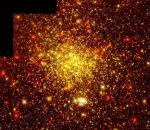 NGC1850: Star Cluster in the LMC
20.06.1997
NGC1850 is a large cluster of stars located a mere 166,000 light-years from Earth in our neighboring galaxy the Large Magellanic Cloud (LMC). The colors in this beautiful Hubble Space Telescope composite image of the cluster reveal different populations of stars.
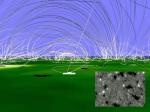 The Magnetic Carpet Of The Sun
6.11.1997
The Sun has a magnetic carpet. Its visible surface appears to be carpeted with tens of thousands of magnetic north and south poles joined by looping field lines which extend outward into the Solar Corona.
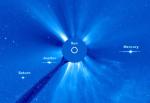 Planets In The Sun
5.05.2000
Today, all five naked-eye planets (Mercury, Venus, Mars, Jupiter, Saturn) plus the Moon and the Sun will at least approximately line-up. As viewed from planet Earth, they will be clustered within about 26 degrees, the closest alignment for all these celestial bodies since February 1962, when there was a solar eclipse!
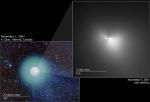 Comet Holmes from the Hubble Space Telescope
28.11.2007
Why did Comet Holmes brighten? The unexpectedly bright Comet 17P/Holmes continues to grace northern skies as a naked-eye addition to the constellation Perseus. Any northern sky enthusiast with a dark sky, a bright curiosity, and a recent sky map should still be able to locate the comet in a few minutes.
 Equinox at Saturn
25.08.2009
What would Saturn's rings look like if the ring plane pointed directly at the Sun? That situation occurred earlier this month when equinox occurred on Saturn. Since the Earth is nearly in the same direction as the Sun from Saturn, the rings appeared to disappear from Earth.
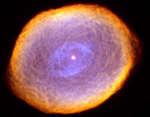 IC 418: The Spirograph Nebula
11.04.2010
What is creating the strange texture of IC 418? Dubbed the Spirograph Nebula for its resemblance to drawings from a cyclical drawing tool, planetary nebula IC 418 shows patterns that are not well understood. Perhaps they are related to chaotic winds from the variable central star, which changes brightness unpredictably in just a few hours.
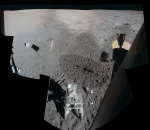 Apollo 14: A View from Antares
5.02.2011
Forty years ago, while looking out the window of Apollo 14's Lunar Module Antares, astronaut Ed Mitchell snapped a series of photos of the lunar surface, assembled into this detailed mosaic by Apollo Lunar Surface Journal editor Eric Jones.
 Superstorm Sandy From Formation to Landfall
7.11.2012
It was the largest hurricane ever recorded in the Atlantic Ocean. The cost of its devastation is still unknown. Pictured above is a movie of Superstorm Sandy taken by the Earth-orbiting GOES-13 satellite over...
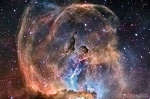 NGC 3576: The Statue of Liberty Nebula
28.09.2016
What's happening in the Statue of Liberty nebula? Bright stars and interesting molecules are forming and being liberated. The complex nebula resides in the star forming region called RCW 57. This image showcases...
 Carina Nebula Panorama from Hubble
23.06.2019
How do violent stars affect their surroundings? To help find out, astronomers created a 48-frame high-resolution, controlled-color panorama of the center of the Carina Nebula, one of the largest star forming regions on the night sky. The featured image, taken in 2007, was the most detailed image of the Carina Nebula yet taken.
|
January February March April May June July August September October |
|||||||||||||||||||||||||||||||||||||||||||||||||