
|
You entered: NASA
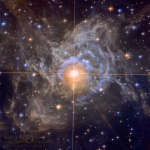 RS Puppis
17.05.2019
Pulsating RS Puppis, the brightest star in the image center, is some ten times more massive than our Sun and on average 15,000 times more luminous. In fact, RS Pup is a Cepheid...
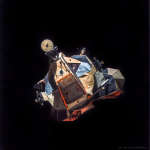 Apollo 17 s Moonship
19.12.2019
Awkward and angular looking, Apollo 17's lunar module Challenger was designed for flight in the near vacuum of space. Digitally enhanced and reprocessed, this picture taken from Apollo 17's command module America shows Challenger's ascent stage in lunar orbit.
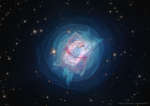 Bright Planetary Nebula NGC 7027 from Hubble
30.06.2020
What created this unusual planetary nebula? NGC 7027 is one of the smallest, brightest, and most unusually shaped planetary nebulas known. Given its expansion rate, NGC 7027 first started expanding, as visible from Earth, about 600 years ago.
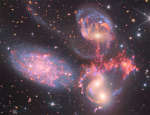 Stephans Quintet from Webb, Hubble, and Subaru
18.07.2022
OK, but why can't you combine images from Webb and Hubble? You can, and today's featured image shows one impressive result. Although the recently launched James Webb Space Telescope (Webb) has a larger mirror than Hubble, it specializes in infrared light and can't see blue -- only up to about orange.
 Tagging Bennu
21.09.2023
The OSIRIS-REx spacecraft's arm reached out and touched asteroid 101955 Bennu on October 20, 2020, after a careful approach to the small, near-Earth asteroid's boulder-strewn surface. Dubbed a Touch-And-Go (TAG) sampling event...
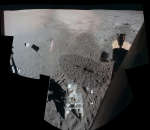 Apollo 14: A View from Antares
17.01.2026
Apollo 14's Lunar Module Antares landed on the Moon on February 5, 1971. Toward the end of the stay astronaut Ed Mitchell snapped a series of photos of the lunar surface while looking out a window, assembled into this detailed mosaic by Apollo Lunar Surface Journal editor Eric Jones.
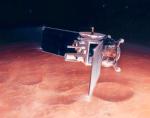 Mars Global Surveyor: Aerobraking
11.09.1997
Completing a 10 month journey, another spacecraft from Earth arrives at Mars today. The Mars Global Surveyor (MGS) is scheduled to fire its main rocket engine for 22 minutes at 6:17 p.m.
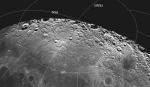 Help Map The Moon
11.09.1998
You can help map the Moon. Early tomorrow morning (Saturday, September 12) the Moon will occult, or pass in front of, the bright star Aldebaran as viewed from some Southern and Eastern areas of the U.S. as well as regions in the Caribbean Sea, Nova Scotia, Newfoundland, Mexico, and Central America.
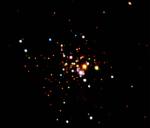 X Ray Stars of 47 Tuc
21.07.2005
Visible light images show the central region of globular cluster 47 Tucanae is closely packed, with stars less than a tenth of a light-year apart. This Chandra false-color x-ray view of central...
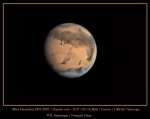 Mars in View
6.12.2007
Very good telescopic views of Mars can be expected in the coming weeks as the Red Planet nears opposition on December 24th. Of course, opposition means opposite the Sun in planet Earth's sky - an arrangement that occurs every 26 months for Mars.
|
January February March April May June July August September October |
|||||||||||||||||||||||||||||||||||||||||||||||||