
|
You entered: cluster
 Millions of Stars in Omega Centauri
27.03.2024
Globular star cluster Omega Centauri, also known as NGC 5139, is 15,000 light-years away. The cluster is packed with about 10 million stars much older than the Sun within a volume about 150 light-years in diameter.
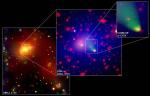 C153 Takes the Plunge
6.09.2004
A comet-like tail of glowing gas, 200,000 light-years long, streams from galaxy C153 as it plunges through galaxy cluster Abell 2125 at nearly 8 million kilometers per hour. Itself a member of the giant cluster of galaxies, C153 may once have been a spiral galaxy like the Milky Way.
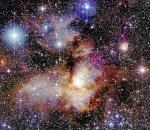 Star-Forming Region RCW38 from 2MASS
17.07.2002
The star cluster in RCW38 was hiding. Looking at the star forming region RCW38 will not normally reveal most of the stars in this cluster. The reason is that the open cluster is so young that it is still shrouded in thick dust that absorbs visible light.
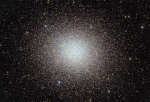 Millions of Stars in Omega Centauri
15.03.2023
Globular star cluster Omega Centauri, also known as NGC 5139, is 15,000 light-years away. The cluster is packed with about 10 million stars much older than the Sun within a volume about 150 light-years in diameter.
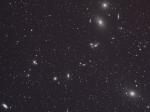 Markarians Chain of Galaxies
15.03.2005
Across the heart of the Virgo Cluster of Galaxies lies a striking string of galaxies known as Markarian's Chain. The chain, pictured above, is highlighted on the upper right with two large but featureless lenticular galaxies, M84 and M86, and connects to the large spiral on the lower left, M88.
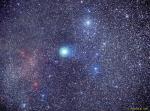 Skyscape with Comet Holmes
8.11.2007
This gorgeous skyscape spans some 10 degrees across the heroic constellation Perseus, about the size of a generous binocular field of view. The deep exposure includes bright stars, emission nebulae, star clusters, and, of course, the famous Comet Holmes. To identify the celestial landmarks, just place your cursor over the image.
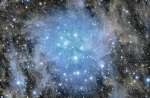 Pleiades Deep Field
21.09.2011
Have you ever seen the Pleiades star cluster? Even if you have, you probably have never seen it like this: all dusty. Perhaps the most famous star cluster on the sky, the bright stars of the Pleiades can be seen without binoculars from even the depths of a light-polluted city.
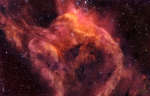 NGC 3572 and the Southern Tadpoles
5.05.2022
This cosmic skyscape features glowing gas and dark dust clouds along side the young stars of NGC 3572. A beautiful emission nebula and star cluster it sails far southern skies within the nautical constellation Carina.
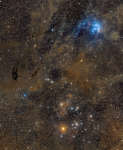 Pleiades to Hyades
5.12.2019
This cosmic vista stretches almost 20 degrees from top to bottom, across the dusty constellation Taurus. It begins at the Pleiades and ends at the Hyades, two star clusters recognized since antiquity in Earth's night sky. At top, the compact Pleiades star cluster is about 400 light-years away.
 APOD: 2025 October 7 Б SN Encore: A Second Supernova Seen Several Times
6.10.2025
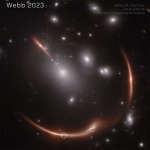
Now a second supernova in this same galaxy is repeating. The cause is the gravitational lens effect of a massive foreground cluster of galaxies (MACS J0138) -- it creates multiple images of a perfectly aligned background galaxy (MRG-M0138). What's particularly interesting is that this background galaxy has young stars that keep blowing up.
|
January February March April May June July August September October |
|||||||||||||||||||||||||||||||||||||||||||||||||