
|
You entered: cluster
 Palomar 13 s Last Stand
24.01.2003
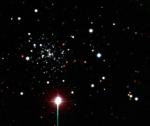
Globular star cluster Palomar 13 has roamed the halo of our Milky Way Galaxy for the last 12 billion years. The apparently sparse cluster of stars just left of center in this composite color digital image, it is one of the smallest, faintest globular clusters known.
 NGC 3572 and the Southern Tadpoles
7.11.2019
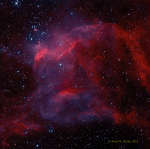
This cosmic skyscape features glowing gas and dark dust clouds along side the young stars of NGC 3572. A beautiful emission nebula and star cluster in far southern skies, the region is often overlooked by astroimagers in favor of its brighter neighbor, the nearby Carina Nebula.
 Markarian s Chain to Messier 64
23.06.2017
Top to bottom, this colorful and broad telescopic mosaic links Markarian's Chain of galaxies across the core of the Virgo Cluster to dusty spiral galaxy Messier 64. Galaxies are scattered through the field of view that spans some 20 full moons across a gorgeous night sky.
 The Massive Stars in Westerlund 1
19.06.2017
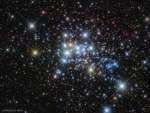
Star cluster Westerlund 1 is home to some of the largest and most massive stars known. It is headlined by the star Westerlund 1-26, a red supergiant star so big that if placed in the center of our Solar System, it would extend out past the orbit of Jupiter.
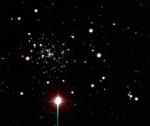 Palomar 13's Last Stand
29.11.2000
Globular star cluster Palomar 13 has roamed the halo of our Milky Way Galaxy for the last 12 billion years. The apparently sparse cluster of stars just left of center in this composite color digital image, it is one of the smallest, faintest globular clusters known.
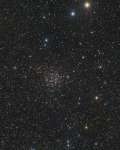 NGC 7789: Caroline s Rose
26.10.2013
Found among the rich starfields of the Milky Way toward the constellation Cassiopeia, star cluster NGC 7789 lies about 8,000 light-years away. A late 18th century deep sky discovery of astronomer Caroline Lucretia Herschel, the cluster is also known as Caroline's Rose.
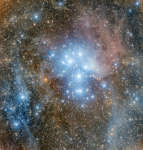 Messier 45: The Daughters of Atlas and Pleione
6.11.2019
Hurtling through a cosmic dust cloud a mere 400 light-years away, the lovely Pleiades or Seven Sisters open star cluster is well-known for its striking blue reflection nebulae. It lies in the night sky toward the constellation Taurus and the Orion Arm of our Milky Way Galaxy.
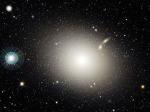 Elliptical Galaxy M87
16.06.2004
Elliptical galaxy M87 is a type of galaxy that looks much different than our own Milky Way Galaxy. Even for an elliptical galaxy, though, M87 is peculiar. M87 is much bigger than an average...
 The Bubble and M52
8.10.2013
To the eye, this cosmic composition nicely balances the Bubble Nebula at the lower left with open star cluster M52 above it and to the right. The pair would be lopsided on other scales, though.
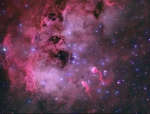 The Tadpoles of IC 410
12.11.2015
This telescopic close-up shows off the otherwise faint emission nebula IC 410. It also features two remarkable inhabitants of the cosmic pond of gas and dust below and right of center, the tadpoles of IC 410. Partly obscured by foreground dust, the nebula itself surrounds NGC 1893, a young galactic cluster of stars.
|
January February March April May June July August September October |
|||||||||||||||||||||||||||||||||||||||||||||||||