
|
You entered: face
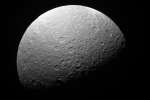 Ancient Craters of Southern Rhea
13.05.2008
Saturn's ragged moon Rhea has one of the oldest surfaces known. Estimated as changing little in the past billion years, Rhea shows craters so old they no longer appear round their edges have become compromised by more recent cratering.
 Io s Surface: Under Construction
17.08.2008
Like the downtown area of your favorite city, the roads you drive to work on, and any self-respecting web site ... Io's surface is constantly under construction. This moon of Jupiter holds the distinction of being the Solar System's most volcanically active body -- its bizarre looking surface continuously formed and reformed by lava flows.
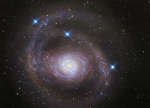 M94: A New Perspective
14.01.2010
Beautiful island universe M94 lies a mere 15 million light-years distant in the northern constellation of the hunting dogs, Canes Venatici. A popular target for astronomers the brighter inner part of the face-on spiral galaxy is about 30,000 light-years across.
 APOD: 2023 November 28 Б Ganymede from Juno
28.11.2023
What does the largest moon in the Solar System look like? Jupiter's moon Ganymede, larger than even Mercury and Pluto, has an icy surface speckled with bright young craters overlying a mixture of older, darker, more cratered terrain laced with grooves and ridges.
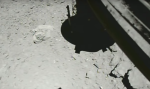 Hayabusa2 Ascends from Asteroid Ryugu
1.11.2018
Will spacecraft Hayabusa2 be able to land safely on asteroid Ryugu? Since arriving in June, pictures show that the surface of kilometer-sized Ryugu is covered with boulders, so that finding a flat enough area for the bus-sized spacecraft to touch down is proving a challenge.
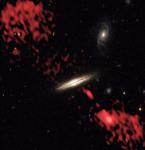 192: The Wrong Galaxy
14.01.2003
Centered above is distant galaxy 0313-192, some one billion light-years away. Radio emission from the galaxy has been mapped by the National Radio Astronomy Observatory's Very Large Array and is shown in red, composited with a visible light image from the Hubble Space Telescope's new Advanced Camera for Surveys.
 ULXs in M74
30.03.2005
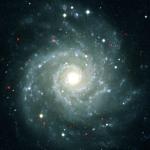
In visual appearance, M74 is a nearly perfect face-on spiral galaxy, about 30 million light-years away toward the constellation Pisces. The red blotches seen in this composite view are ultraluminous x-ray sources (ULXs) mapped by the Chandra X-ray Observatory.
 A Picturesque Venus Transit
3.06.2012
The rare transit of Venus across the face of the Sun in 2004 was one of the better-photographed events in sky history. Both scientific and artistic images flooded in from the areas that could see the transit: Europe and much of Asia, Africa, and North America.
 Northern Mercury
1.12.2012
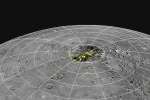
Innermost planet Mercury would probably not be a good location for an interplanetary winter olympics. But new results based on data from the Mercury orbiting MESSENGER spacecraft indicate that it does have substantial water ice in permanently shadowed regions within craters near its north pole.
 Ganymede from Juno
14.06.2021
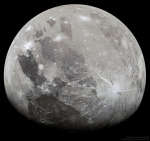
What does the largest moon in the Solar System look like? Jupiter's moon Ganymede, larger than even Mercury and Pluto, has an icy surface speckled with bright young craters overlying a mixture of older, darker, more cratered terrain laced with grooves and ridges.
|
January February March April May June July August |
||||||||||||||||||||||||||||||||||||||||||||||||||||||||