
|
You entered: face
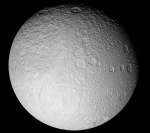 Ice Moon Tethys from Saturn Orbiting Cassini
8.12.2009
What processes formed the unusual surface of Saturn's moon Tethys? To help find out, NASA sent the robotic Cassini spacecraft right past the enigmatic ice moon in 2005. Pictured above is one of the highest resolution images of an entire face of Tethys yet created.
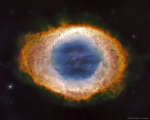 M57: The Ring Nebula
17.04.2018
Except for the rings of Saturn, the Ring Nebula (M57) is probably the most famous celestial band. Its classic appearance is understood to be due to our own perspective, though. The recent mapping...
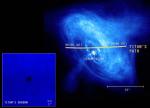 Titan s X Ray
29.04.2004
This June's rare and much heralded transit of Venus will feature our currently brilliant evening star in silhouette, as the inner planet glides across the face of the Sun. But on January 5, 2003 and even rarer transit took place.
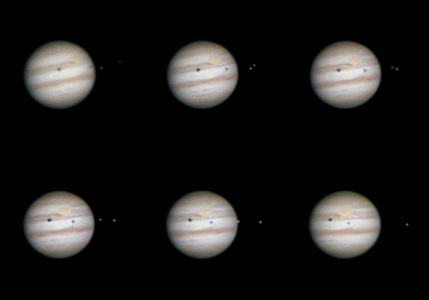 When Moons and Shadows Dance
27.02.2003
It's no wonder Jupiter is a favorite target for even modest earthbound telescopes. The most massive planet in the solar system with four of the largest moons also boasts the famous Great Red Spot, a giant hurricane-like storm system over three hundred years old.
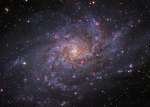 M33: Triangulum Galaxy
20.12.2012
The small, northern constellation Triangulum harbors this magnificent face-on spiral galaxy, M33. Its popular names include the Pinwheel Galaxy or just the Triangulum Galaxy. M33 is over 50,000 light-years in diameter, third largest in the Local Group of galaxies after the Andromeda Galaxy (M31), and our own Milky Way.
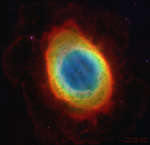 M57: The Ring Nebula from Hubble
17.08.2021
Except for the rings of Saturn, the Ring Nebula (M57) is probably the most famous celestial circle. Its classic appearance is understood to be due to our own perspective, though. The recent mapping...
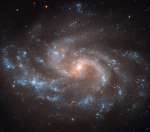 NGC 5584: Expanding the Universe
30.03.2011
Big, beautiful NGC 5548 is more that 50,000 light-years across and lies 72 million light-years away toward the constellation Virgo. The winding spiral arms of this gorgeous island universe are loaded with luminous young star clusters and dark dust lanes. Still, for earthbound astronomers NGC 5548 is not just another pretty face-on spiral galaxy.
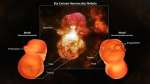 3D Homunculus Nebula
17.07.2014
If you're looking for something to print with that new 3D printer, try out a copy of the Homunculus Nebula. The dusty, bipolar cosmic cloud is around 1 light-year across but is slightly scaled down for printing to about 1/4 light-nanosecond or 80 millimeters.
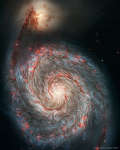 The Magnetic Field of the Whirlpool Galaxy
20.01.2021
Do magnetic fields always flow along spiral arms? Our face-on view of the Whirlpool Galaxy (M51) allows a spectacularly clear view of the spiral wave pattern in a disk-shaped galaxy. When observed with a radio telescope, the magnetic field appears to trace the arms' curvature.
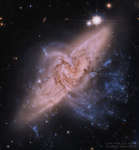 NGC 3314: When Galaxies Overlap
17.11.2021
Why doesn't the nearby galaxy create a gravitational lensing effect on the background galaxy? It does, but since both galaxies are so nearby, the angular shift is much smaller than the angular sizes of the galaxies themselves.
|
January February March April May June July August September |
|||||||||||||||||||||||||||||||||||||||||||||||||