
|
You entered: infrared
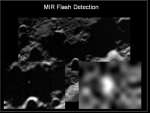 LCROSS Centaur Impact Flash
10.10.2009
This mid-infrared image was taken in the last minutes of the LCROSS flight mission to the Moon. The small white spot (enlarged in the insets) seen within the dark shadow of lunar crater walls is the initial flash created by the impact of a spent Centaur upper stage rocket.
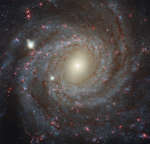 Facing NGC 3344
13.04.2018
From our vantage point in the Milky Way Galaxy, we see NGC 3344 face-on. Nearly 40,000 light-years across, the big, beautiful spiral galaxy is located just 20 million light-years away in the constellation of Leo Minor. This multi-color Hubble Space Telescope close-up of NGC 3344 includes remarkable details from near infrared to ultraviolet wavelengths.
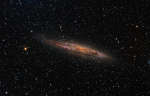 Nearby Spiral Galaxy NGC 4945
22.08.2019
Large spiral galaxy NGC 4945 is seen edge-on near the center of this cosmic galaxy portrait. In fact, it's almost the size of our Milky Way Galaxy. NGC 4945's own dusty disk, young blue star clusters, and pink star forming regions standout in the sharp, colorful telescopic image.
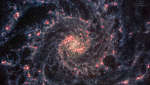 Spiral Galaxy M74: A Sharper View
22.07.2022
Beautiful spiral galaxy Messier 74 (also known as NGC 628) lies some 32 million light-years away toward the constellation Pisces. An island universe of about 100 billion stars with two prominent spiral arms, M74 has long been admired by astronomers as a perfect example of a grand-design spiral galaxy.
 Shakespeare in Space
29.12.2023
In 1986, Voyager 2 became the only spacecraft to explore ice giant planet Uranus close up. Still, this newly released image from the NIRCam (Near-Infrared Camera) on the James Webb Space Telescope offers a detailed look at the distant world. The tilted outer planet rotates on its axis once in about 17 hours.
 M17: Omega Nebula Star Factory
19.09.2000
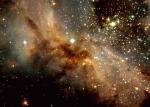
In the depths of the dark clouds of dust and molecular gas known as M17, stars continue to form. Visible in the above recently released representative-color photograph of M17 by the New Technology Telescope are clouds so dark that they appear almost empty of near infrared light.
 The Tarantula Nebula from Spitzer
2.02.2004
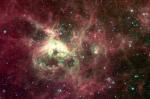
In the heart of monstrous Tarantula Nebula lies one of the most unusual star clusters. Known as NGC 2070 or R136, it is home to a great number of hot young stars. The energetic light from these stars continually ionizes nebula gas, while their energetic particle wind blows bubbles and defines intricate filaments.
 The Kleinmann Low Nebula
2.03.1999
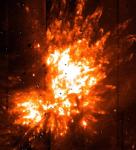
The most active part of the Orion Nebular Cloud Complex is an area known as the Kleinmann-Low Nebula. There, a cluster of young and forming stars is embedded in a molecular cloud filled with dust.
 The Universe Nearby
14.06.2011
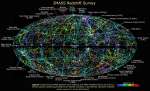
What does the universe nearby look like? This plot shows nearly 50,000 galaxies in the nearby universe detected by the Two Micron All Sky Survey (2MASS) in infrared light. The resulting image is anincredible tapestry of galaxies that provides limits on how the universe formed and evolved.
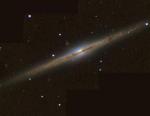 Edge On Spiral Galaxy NGC 891
20.12.1998
Is our Galaxy this thin? We believe so. The Milky Way, like NGC 891 pictured above, has the width of a typical spiral galaxy. Spirals have most of their bright stars, gas, and obscuring dust in a thin disk.
|
January February March April May June July August September October |
|||||||||||||||||||||||||||||||||||||||||||||||||