
|
You entered: infrared
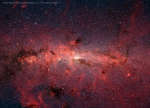 Stars at the Galactic Center
7.03.2015
The center of our Milky Way Galaxy is hidden from the prying eyes of optical telescopes by clouds of obscuring dust and gas. But in this stunning vista, the Spitzer Space Telescope's infrared cameras, penetrate much of the dust revealing the stars of the crowded galactic center region.
 APOD: 2023 August 29 Б Unusual Spiral Galaxy M66 from Webb
29.08.2023
Why isn't spiral galaxy M66 symmetric? Usually, density waves of gas, dust, and newly formed stars circle a spiral galaxy's center and create a nearly symmetric galaxy. The differences between...
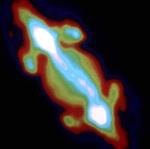 Radio Jupiter
9.10.2003
This view of gas giant Jupiter, made from data recorded at the Very Large Array radio observatory near Socorro, New Mexico, may not look too familiar. In fact, there is no sign of a bright, round planet striped with cloud bands, sporting a Great Red Spot.
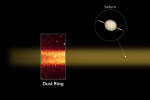 Giant Dust Ring Discovered Around Saturn
13.10.2009
What has created a large dust ring around Saturn? At over 200 times the radius of Saturn and over 50 times the radius of Saturn's expansive E ring, the newly discovered dust ring is the largest planetary ring yet imaged. The ring was found in infrared light by the Earth-orbiting Spitzer Space Telescope.
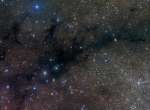 LDN 988 and Friends
24.09.2015
Stars are forming in dark, dusty molecular cloud LDN 988. Seen near picture center some 2,000 light-years distant, LDN 988 and other nearby dark nebulae were cataloged by Beverly T. Lynds in 1962 using Palomar Observatory Sky Survey plates.
 The Protostars within Lynds 483
13.03.2025
Two protostars are hidden in a single pixel near the center of a striking hourglass-shaped nebula in this near-infrared image from the James Webb Space Telescope. The actively forming star system lies in a dusty molecular cloud cataloged as Lynds 483, some 650 light-years distant toward the constellation Serpens Cauda.
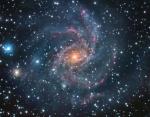 Facing NGC 6946
4.10.2002
From our vantage point in the Milky Way Galaxy, we see NGC 6946 face on. The big beautiful spiral galaxy is located just 10 million light-years away, behind a veil of foreground stars in the high and far-off constellation of Cepheus.
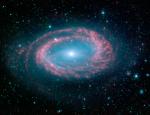 One Armed Spiral Galaxy NGC 4725
1.09.2005
While most spiral galaxies, including our own Milky Way, have two or more spiral arms, peculiar galaxy NGC 4725 has only one. In this false-color Spitzer Space Telescope infrared image, the galaxy's solo spira mirabilis is seen in red, highlighting the emission from dust clouds warmed by newborn stars.
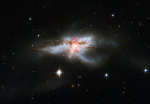 NGC 6240: Merging Galaxies
21.05.2015
NGC 6240 offers a rare, nearby glimpse of a cosmic catastrophe in its final throes. The titanic galaxy-galaxy collision takes place a mere 400 million light-years away in the constellation Ophiuchus. The merging galaxies spew distorted tidal tails of stars, gas, and dust and undergo fast and furious bursts of star formation.
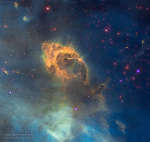 HH 666: Carina Dust Pillar with Jet
14.12.2021
To some, it may look like a beehive. In reality, the featured image from the Hubble Space Telescope captures a cosmic pillar of dust, over two-light years long, inside of which is Herbig-Haro 666 -- a young star emitting powerful jets.
|
January February March April May June July August September October |
|||||||||||||||||||||||||||||||||||||||||||||||||