
|
You entered: infrared
 M1: The Incredible Expanding Crab
15.11.2023
Cataloged as M1, the Crab Nebula is the first on Charles Messier's famous list of things which are not comets. In fact, the Crab Nebula is now known to be a supernova remnant, an expanding cloud of debris from the death explosion of a massive star.
 M1: The Incredible Expanding Crab
8.05.2025
Cataloged as M1, the Crab Nebula is the first on Charles Messier's famous list of things which are not comets. In fact, the Crab Nebula is now known to be a supernova remnant, an expanding cloud of debris from the death explosion of a massive star.
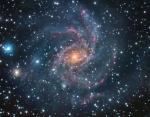 Facing NGC 6946
10.04.2004
From our vantage point in the Milky Way Galaxy, we see NGC 6946 face-on. The big beautiful spiral galaxy is located just 10 million light-years away, behind a veil of foreground stars in the high and far-off constellation of Cepheus.
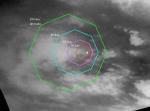 Descent to Titan
14.01.2005
Today's descent to the surface of Titan by the European Space Agency's Huygens probe is the most distant landing ever attempted by a spacecraft from Earth. At 10:13 UT (5:13am...
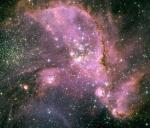 Young Stars of NGC 346
17.11.2005
Star cluster NGC 346 is embedded in the largest star forming region in the Small Magellanic Cloud, some 210,000 light-years distant. The massive stars of NGC 346 are short lived, but very energetic.
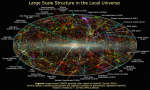 The Universe Nearby
11.12.2007
What does the universe nearby look like? This plot shows over one and a half million of the brightest stars and galaxies in the nearby universe detected by the Two Micron All Sky Survey (2MASS) in infrared light.
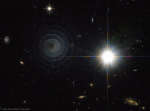 The Extraordinary Spiral in LL Pegasi
11.12.2016
What created the strange spiral structure on the left? No one is sure, although it is likely related to a star in a binary star system entering the planetary nebula phase, when its outer atmosphere is ejected.
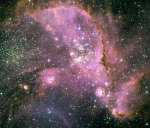 Young Stars of NGC 346
12.05.2022
The massive stars of NGC 346 are short lived, but very energetic. The star cluster is embedded in the largest star forming region in the Small Magellanic Cloud, some 210,000 light-years distant. Their...
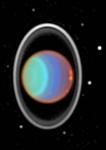 Uranian Moons, Rings, And Clouds
26.11.1997
The giant planet Uranus is faint and featureless when viewed in visible light. But this pair of near-infrared mosaics from the Hubble Space Telescope's NICMOS camera reveals moons, rings, and clouds of this distant gas planet.
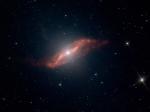 The Galaxy Within Centaurus A
4.03.2006
Peering deep inside Centaurus A, the closest active galaxy to Earth, the Spitzer Space Telescope's penetrating infrared cameras recorded this startling vista in February 2004. About 1,000 light-years across, the twisted cosmic...
|
January February March April May June July August September October |
|||||||||||||||||||||||||||||||||||||||||||||||||