
|
You entered: infrared
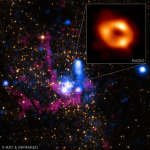 The Milky Way s Black Hole
13.05.2022
There's a black hole at the center of the Milky Way. Stars are observed to orbit a very massive and compact object there known as Sgr A* (say "sadge-ay-star"). But this just released...
 Zeta Oph: Runaway Star
4.01.2024
Like a ship plowing through cosmic seas, runaway star Zeta Ophiuchi produces the arcing interstellar bow wave or bow shock seen in this stunning infrared portrait. In the false-color view, bluish Zeta...
 The Galaxy, the Jet, and a Famous Black Hole
4.05.2023
Bright elliptical galaxy Messier 87 (M87) is home to the supermassive black hole captured in 2017 by planet Earth's Event Horizon Telescope in the first ever image of a black hole. Giant...
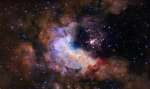 Celestial Fireworks: Into Star Cluster Westerlund 2
4.07.2017
What if you could go right into a cluster where stars are forming? A one-minute, time-lapse, video visualization of just this has been made with 3D computer modeling of the region surrounding the star cluster Westerlund 2, based on images from the Hubble Space Telescope in visible and infrared light.
 The Galaxy, the Jet, and a Famous Black Hole
9.05.2024
Bright elliptical galaxy Messier 87 (M87) is home to the supermassive black hole captured in 2017 by planet Earth's Event Horizon Telescope in the first ever image of a black hole. Giant...
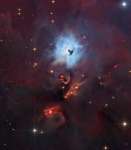 NGC 1999: South of Orion
28.11.2013
South of the large star-forming region known as the Orion Nebula, lies bright blue reflection nebula NGC 1999. At the edge of the Orion molecular cloud complex some 1,500 light-years distant, NGC 1999's illumination is provided by the embedded variable star V380 Orionis.
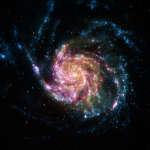 21st Century M101
6.11.2019
One of the last entries in Charles Messier's famous catalog, big, beautiful spiral galaxy M101 is definitely not one of the least. About 170,000 light-years across, this galaxy is enormous, almost twice the size of our own Milky Way Galaxy.
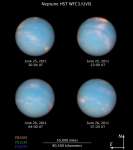 Neptune: Once Around
14.07.2011
Neptune rotates once on its axis in about 16 hours. So, spaced about 4 hours apart these 4 images of the solar system's most distant gas giant cover one Neptune day. Recorded...
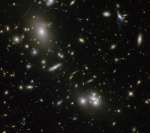 Looking Through Abell 68
8.03.2013
Want to use a cluster of galaxies as a telescope? It's easier than you might think as distant galaxy clusters naturally act as strong gravitional lenses. In accordance with Einstein's theory...
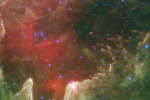 W5: Pillars of Star Creation
16.09.2008
How do stars form? A study of star forming region W5 by the orbiting Spitzer Space Telescope provides clear clues by recording that massive stars near the center of empty cavities are older than stars near the edges.
|
January February March April May June July August September October |
|||||||||||||||||||||||||||||||||||||||||||||||||