
|
You entered: infrared
 APOD: 2025 January 29 Б Dust Shells around WR 140 from Webb
29.01.2025
What are those strange rings? Rich in dust, the rings are likely 3D shells -- but how they were created remains a topic of research. Where they were created is well known: in a binary...
 APOD: 2026 March 6 Б The Astrosphere of HD 61005
6.03.2026
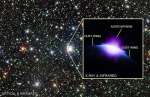
Do young stars blow bubbles? The larger view shows a stellar field observed with the Cerro Tololo Inter-American Observatory in Chile, and the inset highlights HD 61005, a star like our Sun, only 120 light-years away.
 Cartwheel Of Fortune
18.01.2006
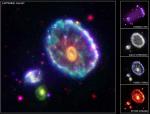
By chance, a collision of two galaxies has created a surprisingly recognizable shape on a cosmic scale - The Cartwheel Galaxy. The Cartwheel is part of a group of galaxies about 400 million light years away in the constellation Sculptor (two smaller galaxies in the group are visible below and left).
 APOD: 2026 June 6 Б Charon: Moon of Pluto
6.06.2026
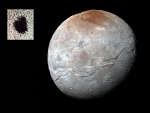
A darkened and mysterious north polar region known to some as Mordor Macula caps this premier view of Charon, Pluto's largest moon. The high-resolution image was captured by the interplanetary space probe New Horizons near its closest approach to distant Pluto on July 14, 2015.
 Generations of Stars in W5
29.08.2008
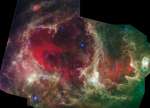
Giant star forming region W5 is over 200 light-years across and about 6,500 light-years away in the constellation Cassiopeia. W5's sculpted clouds of cold gas and dust seem to form fantastic shapes in this impressive mosaic of infrared images from the Spitzer Space Telescope.
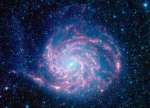 Spitzer s M101
30.12.2009
Big, beautiful spiral galaxy M101 is one of the last entries in Charles Messier's famous catalog, but definitely not one of the least. About 170,000 light-years across, this galaxy is enormous, almost twice the size of our own Milky Way Galaxy.
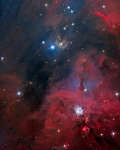 South of Orion
27.01.2022
South of the large star-forming region known as the Orion Nebula, lies bright blue reflection nebula NGC 1999. At the edge of the Orion molecular cloud complex some 1,500 light-years distant, NGC 1999's illumination is provided by the embedded variable star V380 Orionis.
 Webb's First Deep Field
15.07.2023
This stunning infrared image was released one year ago as the James Webb Space Telescope began its exploration of the cosmos. The view of the early Universe toward the southern constellation Volans was achieved in 12.5 hours of exposure with Webb's NIRCam instrument.
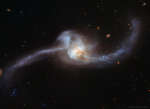 NGC 2623: Merging Galaxies from Hubble
10.01.2018
Where do stars form when galaxies collide? To help find out, astronomers imaged the nearby galaxy merger NGC 2623 in high resolution with the Hubble Space Telescope. Analysis of this and other Hubble images...
 APOD: 2025 May 11 Б The Surface of Venus from Venera 14
11.05.2025
If you could stand on Venus -- what would you see? Pictured is the view from Venera 14, a robotic Soviet lander which parachuted and air-braked down through the thick Venusian atmosphere in March of 1982.
|
January February March April May June July August September October |
|||||||||||||||||||||||||||||||||||||||||||||||||